


If your students freeze when they have to “think of something to say,” give them a story choice instead. These Choose What Happens Next task cards make speaking feel low-pressure because students pick an option (A/B/C), explain why, and continue the story in their own words. The structure builds confidence fast—especially for ESL speaking and mixed-level classes—while still targeting real skills like prediction, inferencing, and storytelling.
Get the resource here: Choose What Happens Next Task Cards (Hot Chocolate Teachables) or Choose What Happens Next Task Cards (TPT).
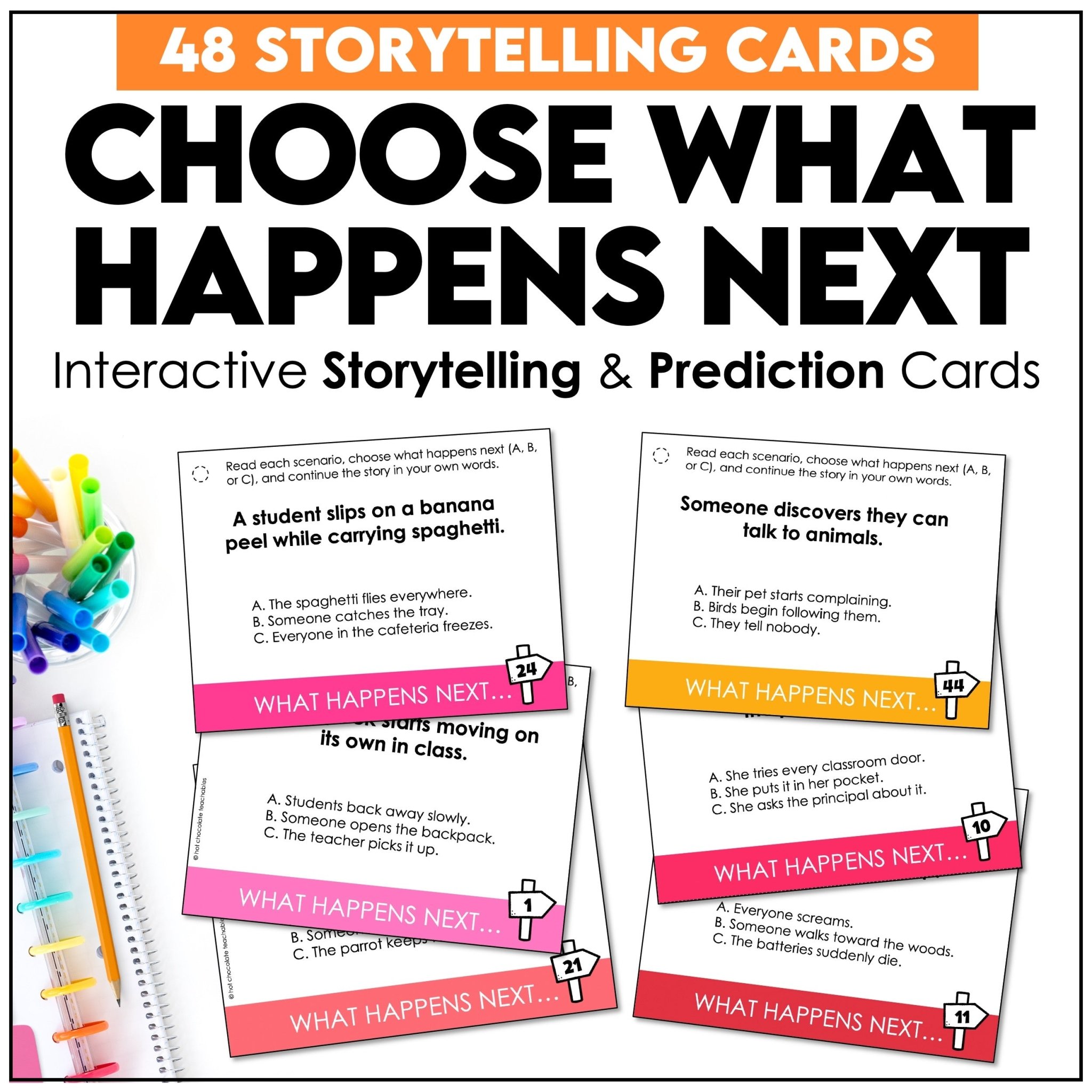
Why Prediction Activities Help Students Think More Deeply
Prediction is more than guessing. When students predict what happens next, they practice a higher-level thinking routine: they use clues, connect to background knowledge, and choose a logical outcome. That’s why inferencing activities and prediction routines show up in reading comprehension standards across grade levels.
In the classroom, prediction tasks also solve a huge teacher problem: students often answer with one-word responses because they don’t know how to expand their thinking. A what happens next prediction activity pushes students to explain and justify—without needing a long written assignment.
What prediction practice teaches (without feeling “heavy”)
- Evidence-based thinking: “I think this because…”
- Cause-and-effect reasoning: “If this happens, then…”
- Story structure: problem → choice → consequence
- Oral language: longer answers, clearer sentences, better fluency
That’s why prediction task cards work so well for both ESL and ELA: students get a clear speaking target with built-in support.
What Are Choose What Happens Next Task Cards?
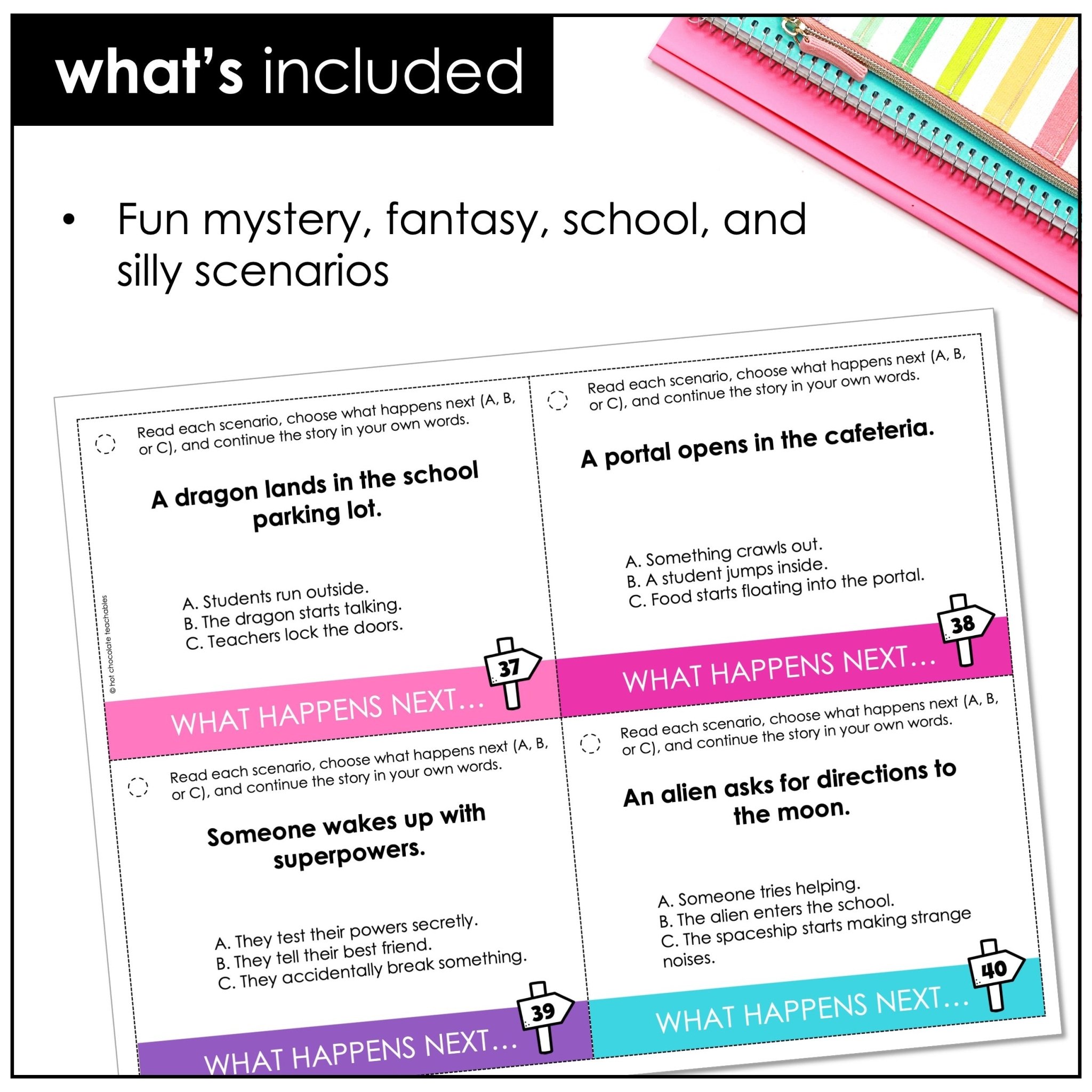
Choose What Happens Next task cards are storytelling task cards with an open-ended format. Each card gives students a short scenario (the “story starter”) and three choices for what could happen next. Students select A, B, or C and then continue the story with their own ending.
Think of it as choose your own adventure task cards—but designed for classroom discussion and writing. Students don’t need to invent a story from nothing. They start with a clear scene, choose a path, and speak or write from there.
How This Activity Works
The best part about these speaking task cards is that the routine is simple. Once you teach it one time, students can run it independently in pairs or small groups—perfect for centers and early finishers.
HowTo format (teacher-friendly steps)
- Time needed: 10–20 minutes (speaking) or 20–35 minutes (writing extension)
- Prep: print (laminate optional), cut cards; optional: assign groups and roles
- Materials: task cards, timer (optional), recording sheet or notebook (optional)
- Read the scenario (teacher, partner, or student reads aloud).
- Choose what happens next (A/B/C).
- Explain the choice using a sentence frame.
- Continue the story with 2–6 more sentences (spoken or written).
- Share and compare endings with another pair or group.
Sentence frames (low-pressure support)
- I think the best choice is ___ because ___.
- I predict ___ will happen next because ___.
- In my story, first ___, then ___, and finally ___.
What went wrong the first time I tried open-ended storytelling: I asked students to “continue the story” with no structure. Half the class wrote one sentence. The fix was adding A/B/C choices and sentence frames. The structure gave students a starting point—and the creativity followed.
Skills Students Practice with Storytelling Task Cards
These aren’t “just fun prompts.” They’re inferencing task cards for speaking and writing that build real academic skills. Because students have to justify a choice and explain cause/effect, they naturally practice longer, clearer language.
Speaking and listening skills
- Speaking in complete sentences (not one-word answers)
- Turn-taking and active listening
- Asking follow-up questions (“Why?” “What happens after that?”)
- Using transition words (first, then, next, finally)
Reading and comprehension skills
- Identifying clues in a short scenario
- Making predictions based on evidence
- Inferencing (“What is the character thinking?” “What might be the problem?”)
Writing skills
- Story starters → expanded narratives
- Organization and sequencing
- Adding details (who/where/when/why)
This is why teachers love storytelling task cards for the classroom: one resource supports speaking, writing, and critical thinking at the same time.
Ways to Use the Cards for Speaking Practice
If you’re looking for speaking task cards for ESL students that don’t cause panic, this format works because students have a “safe” choice first. The A/B/C option reduces pressure and gives students something to react to.
1) Partner Talk (fast, low-pressure routine)
- Partner A reads the scenario.
- Partner B chooses A/B/C and explains why.
- Partner A continues the story for 2–3 sentences.
- Switch roles with a new card.
2) Small-Group Story Circle
Students sit in a circle. One student reads, everyone votes A/B/C, then each student adds one sentence to continue the story. This works well for building community and keeps everyone involved.
3) “Quick Speak” Timed Challenge
Students choose A/B/C and speak for 30 seconds using transition words. You can assess fluency quickly without a formal oral presentation.
How to check speaking without grading everything
Use a quick checklist for one round:
- Student used a sentence frame
- Student gave one reason
- Student used one transition word
- Student asked or answered a follow-up question
This gives you meaningful data without creating a mountain of grading.
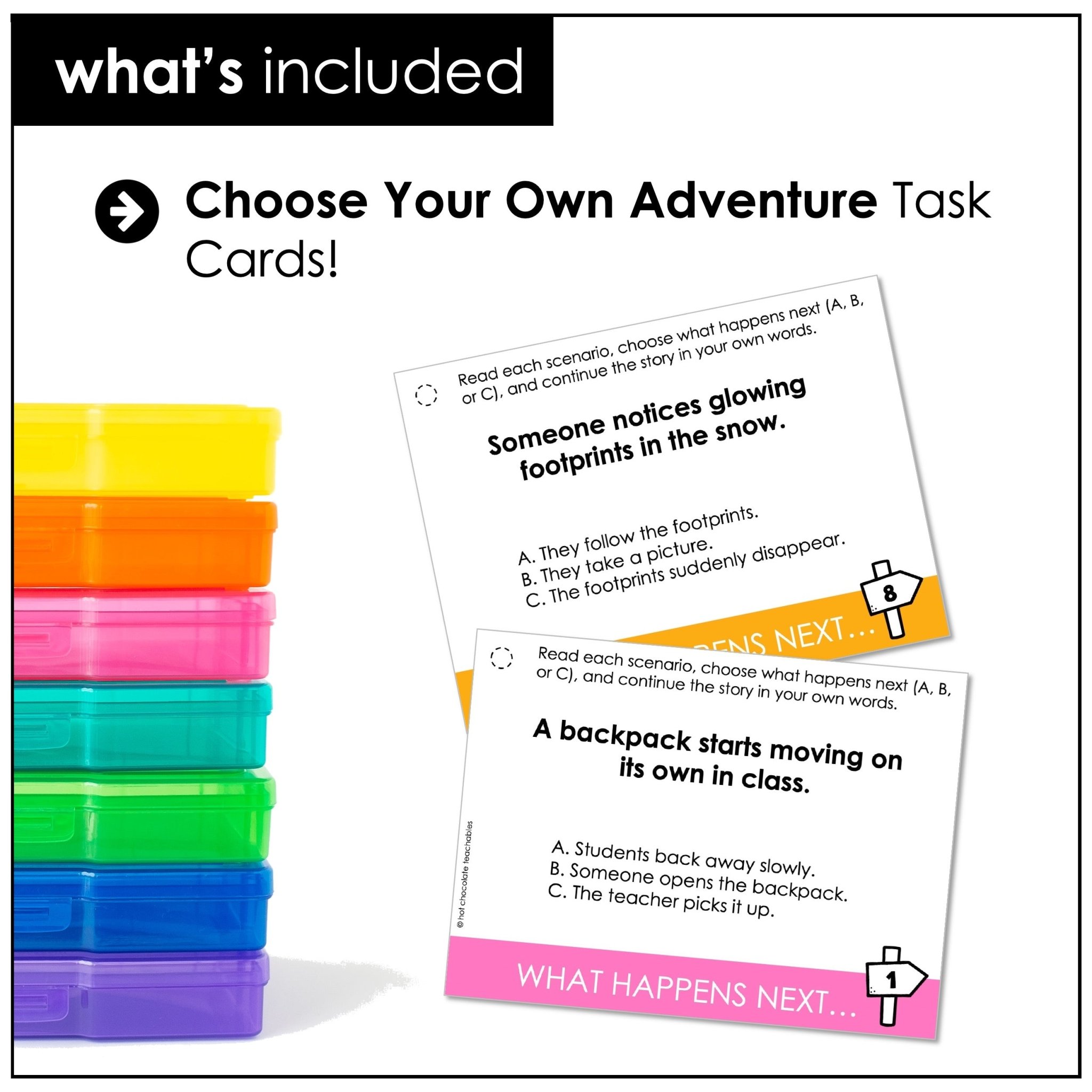
Ways to Use the Cards for Creative Writing
These creative writing task cards are also excellent writing prompts for writing centers. Students already have a scenario and a decision point—so they can spend their energy adding details and organizing ideas.
1) Write a short story (easy writing center routine)
- Copy the scenario (or paste it at the top of the page).
- Circle A/B/C.
- Write 6–10 sentences continuing the story.
- Add a title and an ending sentence that wraps up the problem.
2) Expand one moment (detail writing)
Students choose one sentence from their story and add 3 details: a feeling, a sound, and a description. This is a simple way to improve writing quality without asking students to write longer.
3) Dialogue version (speaking-to-writing bridge)
Students rewrite the story ending as a short dialogue. This supports quotation marks, speech verbs (said/asked/replied), and realistic conversation patterns.
Writing success criteria (what “good” looks like)
- Student used the A/B/C choice clearly
- Story includes sequencing words (first/then/next/finally)
- Story has at least one reason or cause/effect sentence
- Story includes a clear ending
That’s why teachers often use these as story starter task cards for writing centers—the structure helps students finish successfully.
How to Use Them with ESL and Mixed-Level Students
This activity is especially strong for ESL storytelling activities for speaking practice because every student can participate, even if their language is limited. The key is to differentiate the output, not the task.
Easy differentiation (same card, different expectation)
- Newcomers: choose A/B/C + one sentence frame (“I choose A because…”)
- Developing: add 2–3 story sentences using sequencing words
- Stronger students: add a twist (problem, solution, or surprise ending) and ask a follow-up question
Support tools that make it smoother
- Sentence frames on the board
- A mini word bank (feelings, actions, transitions)
- Role cards (reader, chooser, storyteller, question asker)
Common ESL mistake: students stop after choosing A/B/C.
Fix: require “choice + reason + next sentence” every time. That small rule builds fluency quickly.
What’s Included in the Task Card Set
This set is designed as prediction task cards for students that feel like a game while building deep thinking and language. You can use it for speaking, writing, or both.
Grab it here: Choose What Happens Next Task Cards (Hot Chocolate Teachables) or Choose What Happens Next Task Cards (TPT).
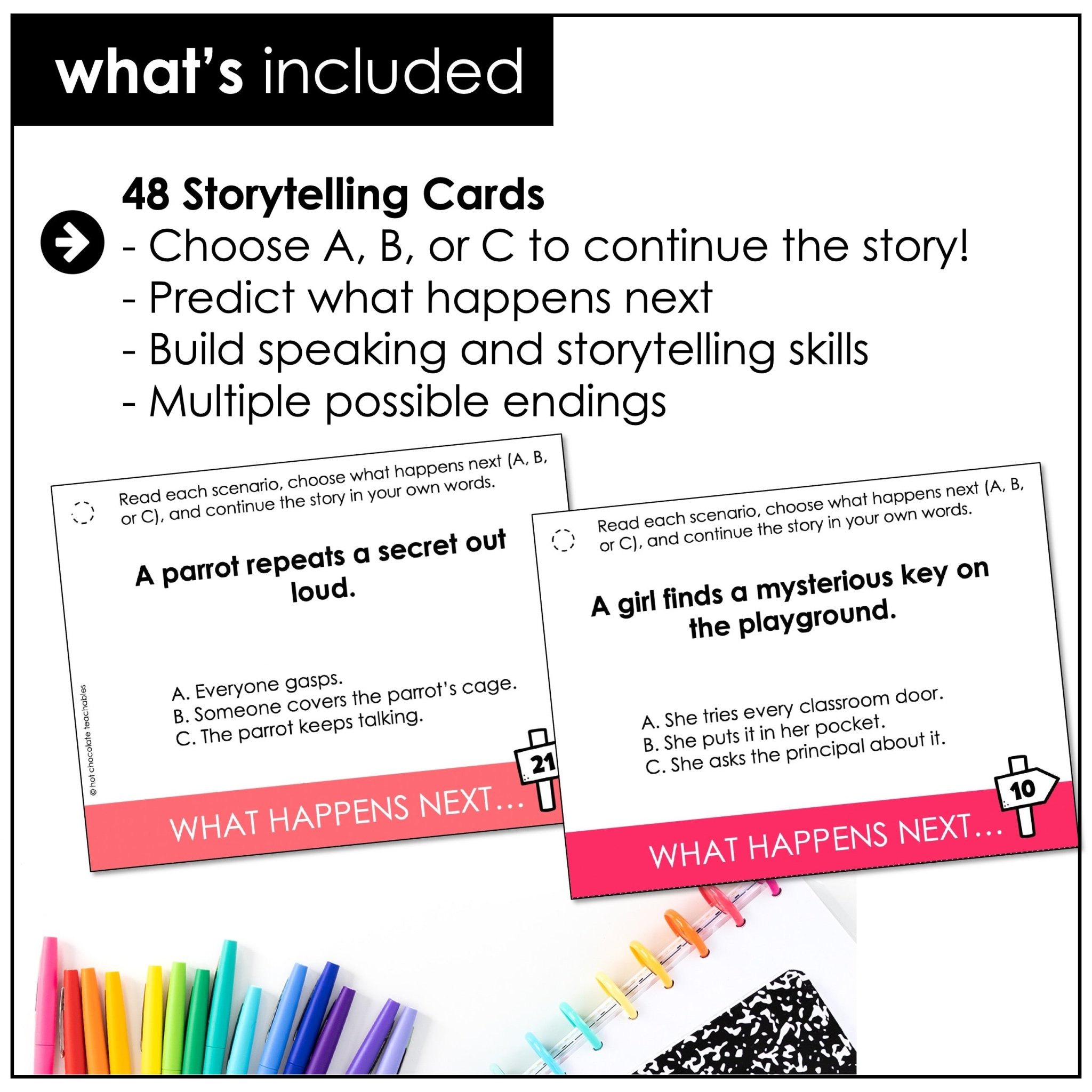
- 48 open-ended storytelling prompt cards
- Each card includes an original scenario + A/B/C options
- Print-and-go format (easy to cut and reuse)
- Great for speaking, writing prompts, and discussion routines
Print once, reuse forever: laminate the cards, store in a photo case or task card box, and you’ve got instant speaking practice any time you need it.
Easy Classroom Ideas for Using the Cards
These ELA task cards fit into almost any part of your day—especially when you need meaningful practice that feels fun.
- Bell ringer: one card on the board; quick partner talk
- Speaking center: students complete 3 cards with a timer and sentence frames
- Writing center: students choose one card and write a full story ending
- Early finishers: grab a card and record a 60-second story on a tablet
- Small group intervention: use cards to build complete sentence output
- Sub plans: predictable routine + clear student accountability
Success looks like: students can (1) make a prediction, (2) explain a reason, and (3) extend the story with clear sequencing. When they can do that, you’re building real inferencing, oral language, and storytelling skills—not just “talk time.”
Shop the Choose What Happens Next Task Cards
- Choose What Happens Next Task Cards (Hot Chocolate Teachables)
- Choose What Happens Next Task Cards (TPT)
More Blog Posts You Might Like
- Five ESL speaking activities that actually get students talking (low-prep routines)
- Low-prep ESL speaking games for the first week of school (build routines and confidence)
- Teacher Toolkit Membership: unlimited ESL resources for busy teachers
Created by Hot Chocolate Teachables
