


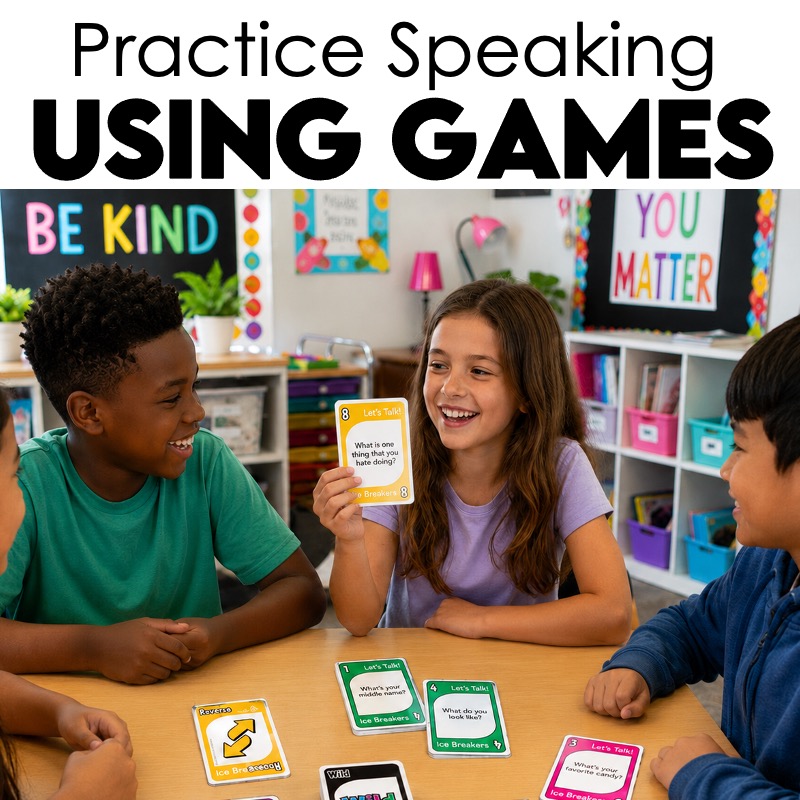
How Speaking Games Transform ESL Learning
Speaking games work better than worksheets for ESL students when the goal is real communication, confidence, fluency, and active language use. Worksheets can be helpful for grammar review, vocabulary practice, and independent work, but they rarely give students enough chances to actually speak English with a purpose. If students only fill in blanks, circle answers, or match words to definitions, they may understand English on paper but still freeze when it is time to have a conversation.
ESL students become stronger speakers by using English in meaningful ways. They need to ask questions, answer classmates, explain opinions, describe pictures, make choices, listen carefully, and respond in real time. Speaking games create those opportunities naturally. Instead of completing another quiet worksheet, students interact, move, think, laugh, and communicate.
As a former ESL teacher, I have seen the difference many times. A student who barely writes a sentence on a worksheet may suddenly speak more when the activity feels like a game. A reluctant speaker may answer a question card with a partner. A quiet student may explain why one picture does not belong. A beginner may feel more comfortable rolling dice and speaking about a familiar topic than answering a long written prompt.
This does not mean worksheets are bad. Worksheets still have a place in the ESL classroom. They can help students practice specific grammar points, complete independent review, and show what they understand. But if your goal is to build speaking confidence and fluency, students need more than worksheets. They need structured speaking games that help them use English in real conversations.
In this guide, you’ll learn why speaking games are so effective for ESL students, how they support fluency and confidence, and how to use low-prep speaking activities to create a more interactive English classroom.
Why Worksheets Are Not Enough for ESL Speaking Practice
Worksheets are easy to print, simple to assign, and usually quick to grade. That is why so many teachers rely on them. They can be useful when students need to review verb tenses, practice vocabulary, complete sentence corrections, or work independently.
The problem is that worksheets often focus on recognition instead of communication. Students may recognize the correct answer, but they may not be able to produce language independently. They may know which verb form to circle, but they may still struggle to explain their weekend, ask a classmate a question, or describe an object in English.
When students only complete worksheets, they may miss important parts of language learning, including:
- Speaking fluency
- Listening comprehension
- Turn-taking
- Pronunciation practice
- Spontaneous language use
- Question formation
- Confidence in conversation
- Explaining ideas with details
- Responding to classmates
- Using vocabulary in real context
A worksheet might ask students to write the correct word. A speaking game asks students to use that word while communicating with another person. That difference matters.
The Biggest Difference: Worksheets Practice English, Speaking Games Use English
One of the easiest ways to understand the difference is this:
Worksheets help students practice English on paper. Speaking games help students use English with people.
Both can be valuable, but they do not build the same skills. If students are preparing for real-life communication, they need activities that require real interaction.
For example, a worksheet might ask:
- Write three foods.
- Circle the correct verb.
- Match the question to the answer.
- Complete the sentence.
A speaking game might ask students to:
- Tell a partner about their favorite food.
- Ask three classmates a question.
- Explain why one picture does not belong.
- Roll a topic and speak about it for one minute.
- Answer an open-ended question and ask a follow-up.
The second set of tasks requires students to think, listen, speak, respond, and communicate. That is where fluency begins to grow.
Why Speaking Games Improve ESL Fluency
Fluency develops through repeated opportunities to speak. Students need to practice retrieving words, forming sentences, listening to responses, and continuing conversations. Speaking games make this practice feel natural and less intimidating.
During a good ESL speaking game, students are not simply repeating memorized phrases. They are using English to complete a task, answer a question, solve a problem, or share an idea. This creates meaningful repetition.
Speaking games improve fluency because they help students:
- Produce language more quickly
- Use vocabulary in context
- Respond without overthinking every word
- Practice sentence patterns repeatedly
- Gain confidence through low-pressure interaction
- Hear classmates model different answers
- Build comfort with real conversation
When students play speaking games regularly, they begin to speak with more ease. They may still make mistakes, but they become more willing to try. That willingness is one of the most important steps toward fluency.
Speaking Games Lower Anxiety for English Learners
Many ESL students feel nervous when they have to speak English. They may worry about pronunciation, grammar mistakes, vocabulary gaps, or being judged by classmates. Worksheets feel safer because students can work quietly and avoid speaking aloud.
However, avoiding speaking does not build speaking confidence.
The right speaking game can reduce anxiety because it gives students structure. They are not being asked to “just talk.” They have a card, a prompt, a picture, a dice roll, or a game rule to follow. This structure makes speaking feel more manageable.
Speaking games also shift the focus away from perfection. Students are trying to complete a task or play a game, so the atmosphere feels more relaxed. This helps students take language risks and participate more often.
Start with Low-Pressure Questions: Ice Breaker Card Game
One of the easiest ways to introduce speaking games is with open-ended question cards. These are especially helpful at the beginning of the year, with new students, or anytime a class needs more confidence and connection.
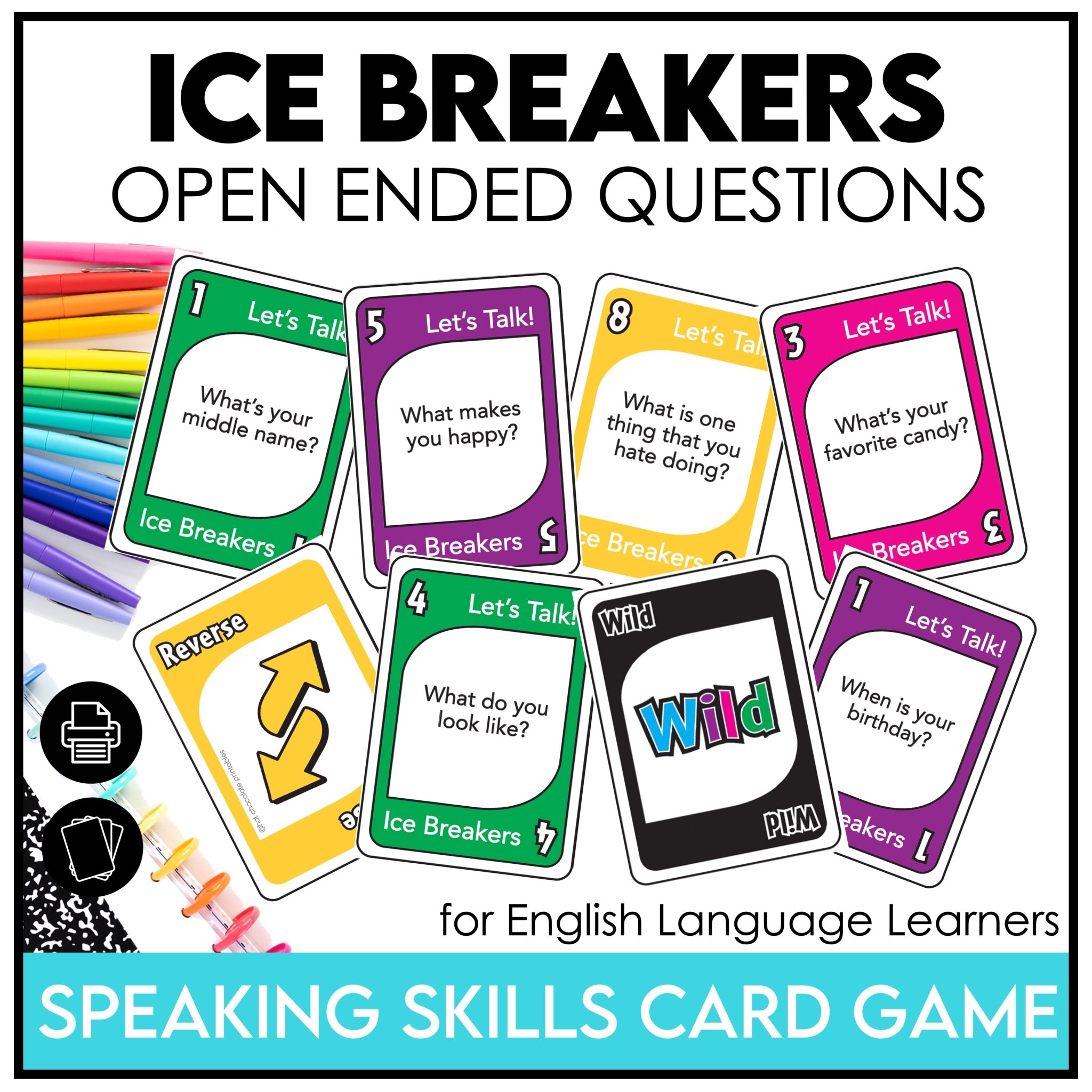
The Ice Breaker Card Game gives students simple, open-ended questions that help them talk about themselves and learn about classmates. Instead of filling out a worksheet about personal information, students answer real questions in pairs, groups, or whole-class games.
Questions like “What makes you happy?” or “What is your favorite candy?” are simple enough for many learners to understand, but they can also lead to longer conversations when students are ready.
This makes the activity flexible for different English levels.
Why This Works Better Than a Worksheet
A worksheet might ask students to write one sentence about themselves. The Ice Breaker Card Game asks students to speak, listen, and respond. That turns language practice into real interaction.
Students practice:
- Answering personal questions
- Giving reasons
- Listening to classmates
- Asking follow-up questions
- Building classroom community
- Speaking in complete sentences
- Sharing opinions and preferences
For shy students, you can use the cards in pairs first. For more confident students, you can ask them to expand their answers or ask a classmate a follow-up question.
Simple Classroom Uses
- Use one card as a daily speaking warm-up.
- Place cards in a basket for morning meeting.
- Have students answer in pairs before sharing with the class.
- Use cards as early finisher speaking prompts.
- Let students choose one card and interview a classmate.
You can also find Ice Breaker Card Game on Teachers Pay Teachers.
Speaking Games Create More Student Talk Time
One of the biggest benefits of speaking games is that they increase student talk time. In many classrooms, the teacher does most of the talking. Students listen, copy, complete worksheets, and answer occasional questions.
But English learners need time to speak.
If one student answers while everyone else listens, only one student is practicing speaking. If students work in pairs or small groups with a speaking game, many students can speak at the same time.
This is why speaking games are so useful for ESL classrooms. They multiply opportunities to use English.
For example, in a class of 24 students:
- Whole-class question: one student speaks at a time.
- Worksheet: students may not speak at all.
- Pair speaking game: 12 conversations happen at once.
- Small-group speaking game: every student has repeated turns.
The more students speak, the more comfortable they become.
Use Dice to Encourage Student-Led Speaking: ESL Speaking Dice Game
Dice games are powerful because they add choice, chance, and structure. Students are often more willing to speak when a dice roll chooses the topic or prompt. It feels playful, not forced.
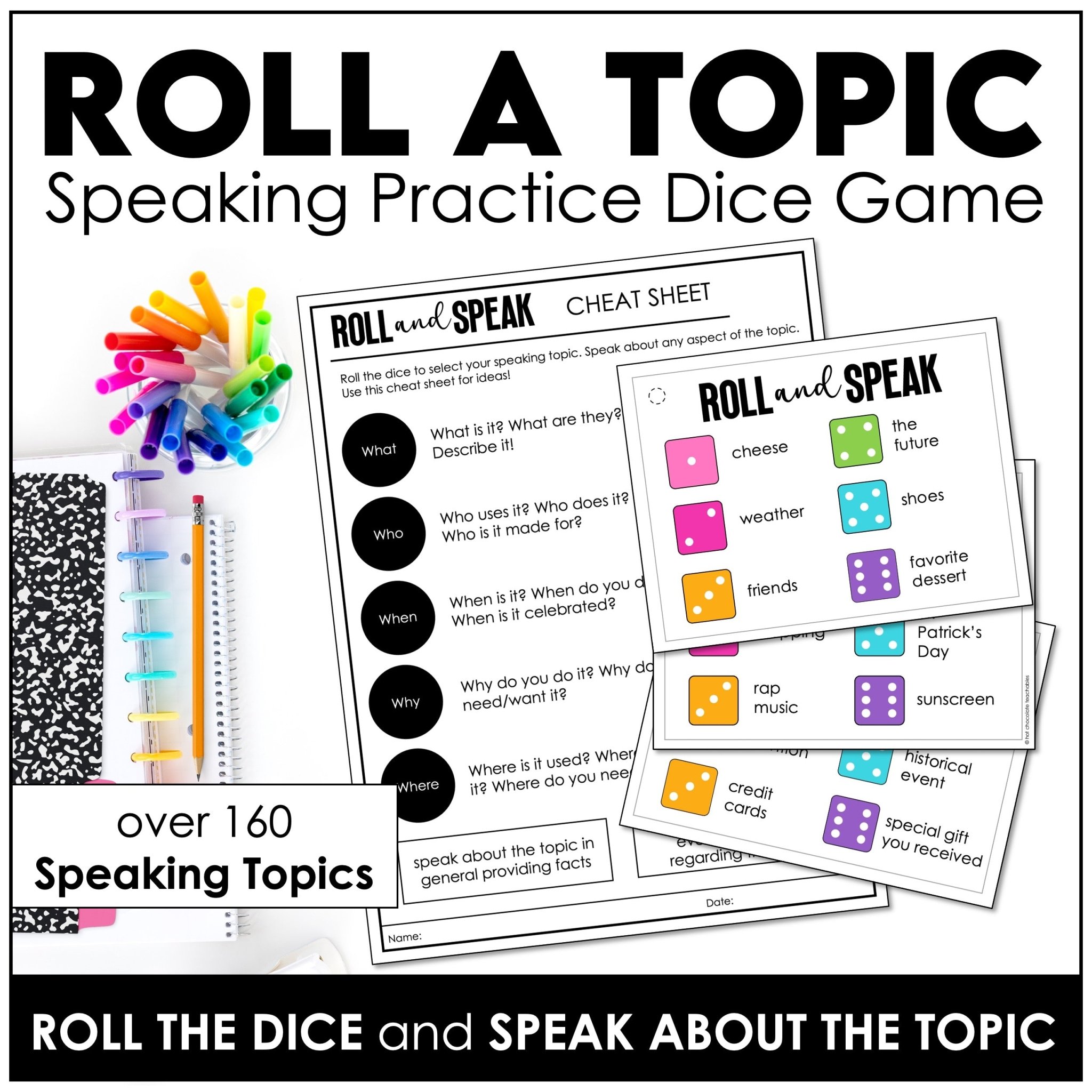
The ESL Speaking Dice Game gives students basic vocabulary topics and encourages them to speak about the topic they roll. This student-led format helps students practice speaking without needing the teacher to control every question.
Instead of completing a vocabulary worksheet, students use vocabulary as a starting point for conversation. They may roll a topic such as weather, shoes, friends, favorite dessert, music, or the future. Then they speak about the topic using prompts or question words to guide their response.
Why Dice Games Build Fluency
Dice games help students produce longer answers because they are not simply giving a right or wrong response. They are speaking about a topic. This encourages students to describe, explain, give examples, and connect ideas.
Students can use question words to expand their speaking:
- What: What is it? What do you know about it?
- Who: Who uses it? Who likes it?
- When: When do you use it? When is it important?
- Where: Where do you see it? Where do people use it?
- Why: Why do people like it? Why is it useful?
- How: How do you use it? How does it work?
This simple structure helps students move from short answers to more developed speech.
How to Differentiate the Dice Game
For beginners, students can say one sentence about the topic.
For intermediate students, ask for three details.
For advanced students, require students to speak for 30–60 seconds, ask a follow-up question, or compare the topic to another idea.
This makes the activity useful in mixed-level ESL classrooms because students can participate at their own level while practicing the same speaking routine.
Simple Classroom Uses
- Use it as a speaking warm-up.
- Place it in a conversation center.
- Use it for partner speaking practice.
- Use it after vocabulary instruction.
- Have students write a short response after speaking.
You can also find ESL Speaking Dice Game on Teachers Pay Teachers.
Speaking Games Push Students Beyond One-Word Answers
One common problem with worksheets is that they often allow students to give very short answers. Students may write one word, choose one option, circle one answer, or copy one sentence. While this can be useful for checking accuracy, it does not always help students build the language they need for real conversations.
Speaking games encourage students to expand their thinking. They are often asked to explain, compare, describe, justify, agree, disagree, or give examples. These are the skills students need when they use English outside of a worksheet.
For example, instead of simply writing “apple” under a picture, students might explain why an apple belongs in one group but not another. Instead of matching a question to an answer, they might ask a partner a real question and respond to the answer. Instead of circling the correct word, they might use that word in a conversation.
This is why speaking games are so powerful for ESL fluency. They turn passive practice into active language production.
Build Critical Thinking with Odd One Out Discussion Cards
Some of the best ESL speaking activities are not only about conversation. They also require students to think carefully. Critical thinking speaking activities help students move beyond basic answers and explain their reasoning in English.
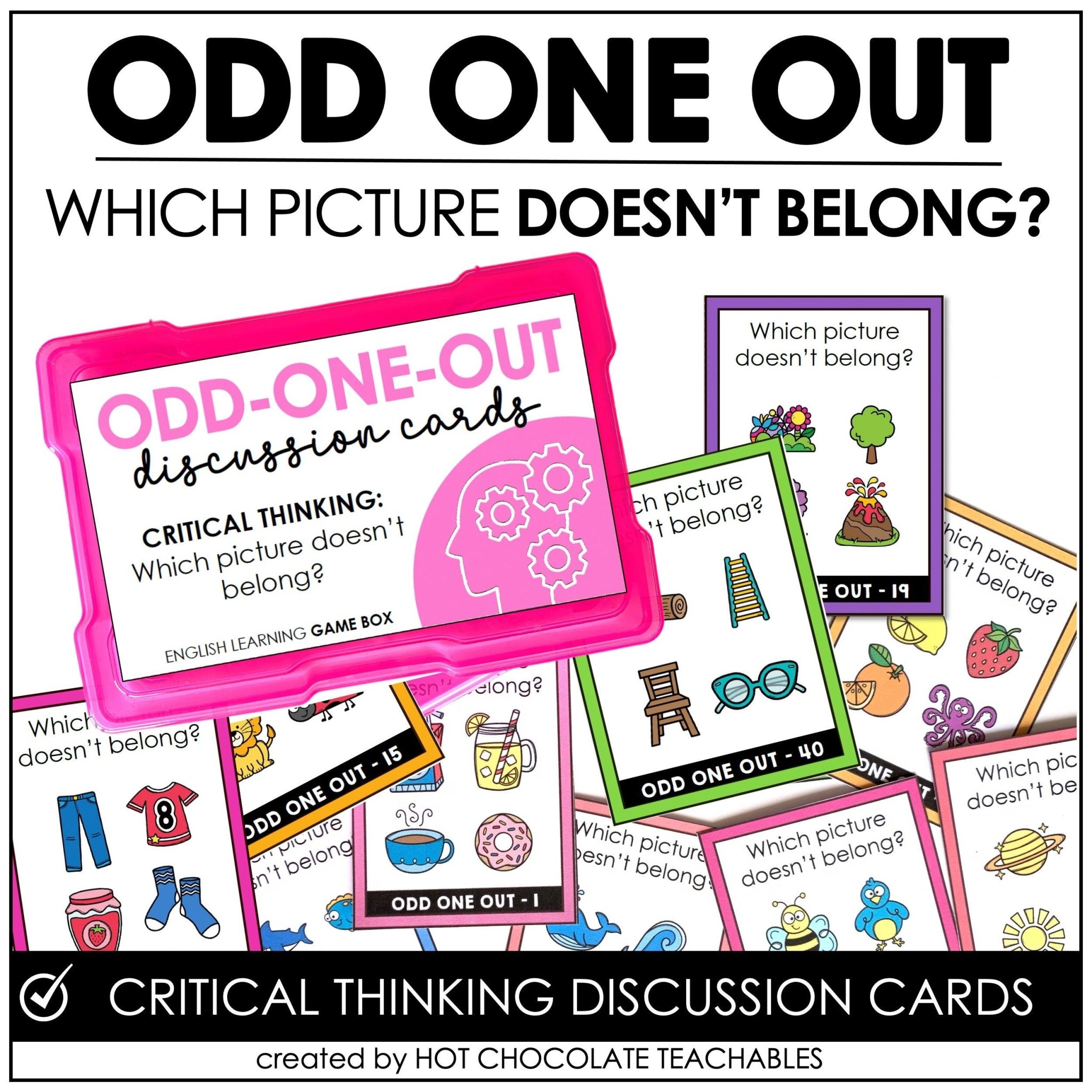
The Odd One Out Discussion Cards ask students to look at a group of pictures and decide which picture does not belong. The real language practice happens when students explain why.
This type of speaking game works especially well because there can often be more than one possible answer. Students may choose different pictures for different reasons, which naturally leads to discussion.
For example, if students see a tree, flowers, a volcano, and a bush, one student might say the volcano does not belong because it is not a plant. Another student might say the flowers do not belong because they are the only colorful item. A third student might choose the tree because it is the tallest.
Each answer requires reasoning, vocabulary, comparison, and explanation.
Why Odd One Out Works Better Than a Worksheet
A worksheet might ask students to circle the item that does not belong. That checks recognition. But a speaking game asks students to explain their thinking. That builds communication.
Students practice language such as:
- I think ___ does not belong because ___.
- These are similar because ___.
- This one is different because ___.
- I agree with ___ because ___.
- I disagree because ___.
- Another possible answer is ___.
These sentence frames support ESL students while helping them use academic speaking language in a natural way.
Skills Students Practice
- Critical thinking
- Explaining opinions
- Comparing and contrasting
- Using descriptive vocabulary
- Justifying answers
- Listening to different viewpoints
- Speaking in complete sentences
- Using evidence from pictures
How to Use Odd One Out Cards in Class
There are many simple ways to use these cards in an ESL classroom.
- Show one card to the whole class and discuss several possible answers.
- Place students in pairs and have them agree on one answer.
- Ask groups to find two different possible answers.
- Use the cards as a speaking station.
- Have students write their reason after discussing.
- Use the cards for warm-ups, early finishers, or small group intervention.
For beginner students, allow short answers with sentence frames. For intermediate students, require a reason. For advanced students, ask them to defend two possible answers or respond to a classmate’s idea.
You can also find this ODD ONE OUT cards – Speaking Activity on Teachers Pay Teachers.
Speaking Games Help Students Listen More Carefully
Speaking games are not only speaking activities. They are listening activities too.
When students play a speaking game, they usually need to listen to a partner, understand a response, decide whether they agree, ask a follow-up question, or wait for their turn. These listening skills are essential for real communication.
Worksheets can sometimes become silent tasks. Students work alone, finish the page, and turn it in. Speaking games create interaction. Students must pay attention to what classmates say because the next part of the game often depends on the answer.
This kind of listening practice is especially important for English language learners. Students need repeated exposure to different voices, accents, sentence patterns, and vocabulary choices. Peer interaction gives them more opportunities to hear English in a meaningful setting.
Speaking Games Build Classroom Community
Another reason speaking games work better than worksheets is that they help students connect with one another. A worksheet may help students practice a skill, but it rarely helps them learn about classmates, build trust, or feel part of a classroom community.
Speaking games create shared experiences. Students laugh, ask questions, compare answers, make decisions, and discover common interests. This matters because students are more likely to participate when they feel comfortable in the classroom.
For ESL students, classroom community is especially important. Students may already feel nervous about speaking English. When they know their classmates and feel safe making mistakes, they are more willing to participate.
This is why getting-to-know-you games, question cards, dice games, and discussion cards are so useful throughout the school year, not just during the first week.
Speaking Games Create Natural Repetition
Repetition is important in language learning, but repeated worksheet drills can quickly become boring. Speaking games create repetition in a more natural way.
Students may use the same sentence frame many times during a game, but each answer feels different because the topic, partner, or prompt changes.
For example, students might repeat:
- I think ___ because ___.
- My answer is ___.
- I agree with ___.
- Can you tell me more?
- In my opinion, ___.
This repeated language helps students build automaticity. Over time, phrases become easier to use because students have practiced them in real conversations.
The goal is not perfect memorization. The goal is comfortable, repeated use of useful English structures.
Use a Speaking Toolkit for Year-Round Practice
One challenge teachers face is keeping speaking practice fresh. If students use the same type of activity every day, they may lose interest. A variety of speaking games helps students stay engaged while practicing different communication skills.
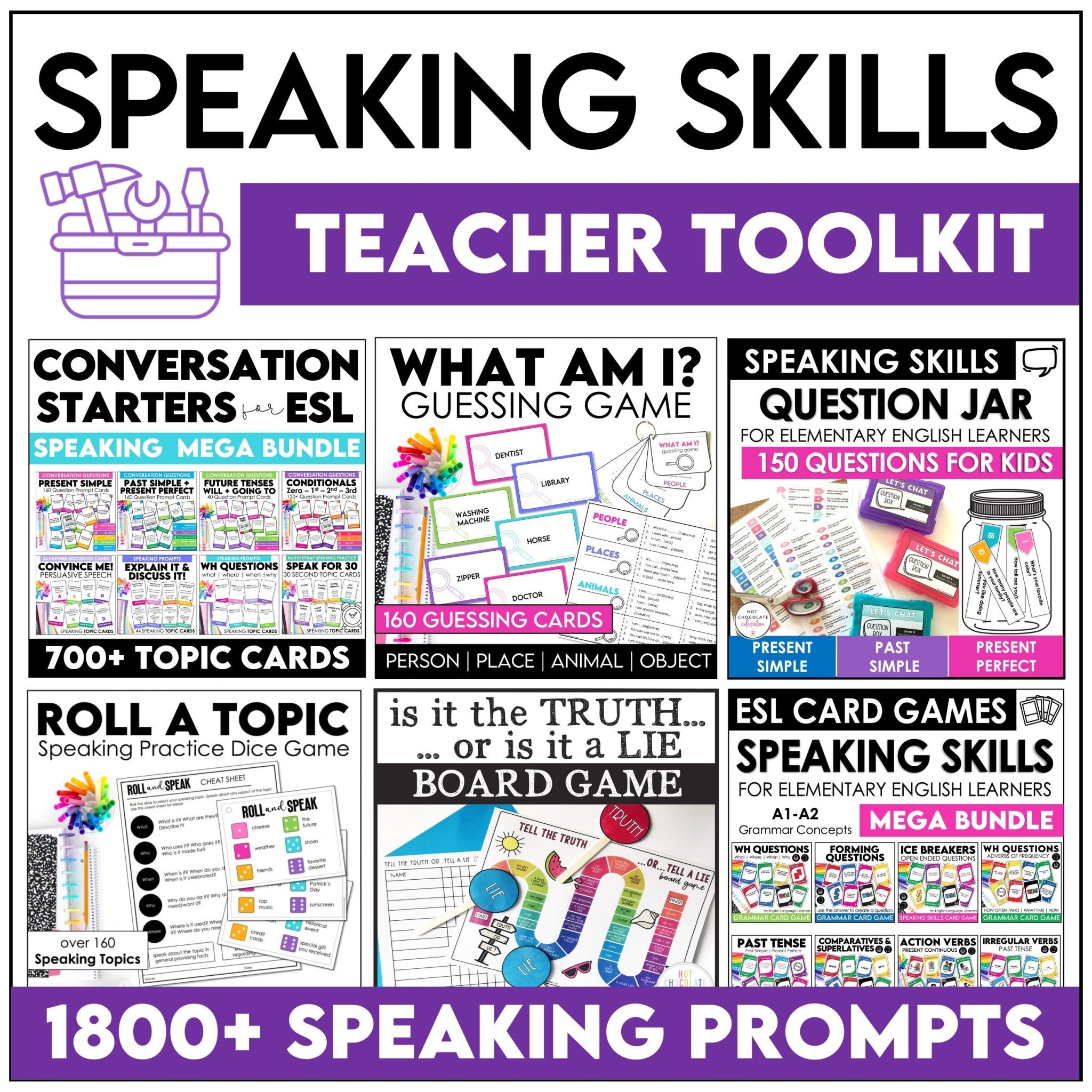
The ESL Speaking Skills Starter Kit gives teachers a collection of speaking games, question cards, topic prompts, guessing games, conversation activities, and classroom speaking resources that can be used throughout the year.
This type of resource is helpful because ESL speaking practice should not be a once-a-week activity. Students need frequent opportunities to speak in different ways.
A strong speaking routine may include:
- Question cards for warm-ups
- Dice games for student-led speaking
- Guessing games for vocabulary practice
- Conversation prompts for partner talk
- Board games for small groups
- Critical thinking cards for discussion
- Topic cards for fluency practice
Why Variety Matters
Worksheets often follow the same pattern: read, write, answer, check. Speaking games can vary widely. Students may roll dice, draw cards, guess an object, answer questions, compare pictures, move around the room, or discuss a topic.
This variety helps students practice different types of communication.
They may practice:
- Describing
- Explaining
- Asking questions
- Giving opinions
- Making guesses
- Justifying answers
- Retelling information
- Comparing ideas
- Agreeing and disagreeing
The more types of speaking students practice, the more flexible and confident they become.
How Teachers Can Use a Speaking Toolkit
A speaking toolkit can be used in many simple ways without adding extra planning time.
- Use one card as a daily bell ringer.
- Set up a speaking station during centers.
- Use topic cards for early finishers.
- Play a speaking game on Fridays.
- Use question cards after grammar lessons.
- Assign partner speaking before writing.
- Use games for review before assessments.
You can also find this ESL Speaking Skills Starter Kit on Teachers Pay Teachers.
Worksheets vs. Speaking Games: What Students Actually Practice
Worksheets and speaking games both have a place in the ESL classroom, but they develop different skills. Understanding the difference helps teachers choose the right activity for the right goal.
| Worksheets | Speaking Games |
|---|---|
| Students often work alone. | Students interact with classmates. |
| Answers are often short. | Students explain and expand ideas. |
| Focus is often on accuracy. | Focus includes communication and fluency. |
| Students recognize language. | Students produce language. |
| Teacher checks answers later. | Students receive immediate interaction. |
| Tasks may feel repetitive. | Games feel varied and engaging. |
| Little student talk time. | More student talk time. |
| Useful for review and assessment. | Useful for confidence, fluency, and communication. |
The goal is not to eliminate worksheets completely. The goal is to make sure students also have enough opportunities to use English actively.
How to Combine Worksheets and Speaking Games
A balanced ESL classroom can include both worksheets and speaking games. The key is using each one for the right purpose.
Worksheets are useful for:
- Independent practice
- Grammar review
- Homework
- Written assessment
- Vocabulary matching
- Error correction
Speaking games are useful for:
- Fluency practice
- Conversation skills
- Vocabulary use
- Listening practice
- Student engagement
- Confidence building
- Classroom interaction
A simple lesson might follow this structure:
- Teach or review the language target.
- Use a short worksheet for controlled practice.
- Move into a speaking game for communication practice.
- Have students reflect or write after speaking.
This approach gives students both accuracy practice and real communication practice.
Final Thoughts: Speaking Games Create the Language Practice Students Actually Need
If your goal is to help students communicate confidently in English, speaking games deserve a regular place in your classroom routine. Worksheets can support grammar instruction, vocabulary review, and written practice, but they cannot replace the real communication opportunities that students experience when they speak with classmates.
Speaking games encourage students to think, listen, explain, describe, justify, question, and interact. They transform language from something students complete on paper into something students actively use. This shift is what helps learners develop confidence, fluency, and communication skills.
Resources like the Ice Breaker Card Game, ESL Speaking Dice Game, Odd One Out Discussion Cards, and the ESL Speaking Skills Starter Kit make it easy to build meaningful speaking opportunities into your lessons without adding hours of preparation.
The best ESL classrooms balance accuracy and communication. Students need to learn grammar and vocabulary, but they also need opportunities to use that language in authentic ways. Speaking games help bridge that gap.
When students are laughing, discussing, questioning, and sharing ideas, they are doing much more than playing a game. They are building the communication skills they need to become successful English speakers.
Frequently Asked Questions About ESL Speaking Games
Why are speaking games important in an ESL classroom?
Speaking games provide opportunities for students to actively use English instead of simply recognizing language on a worksheet. They promote fluency, confidence, listening skills, and meaningful communication.
Do speaking games work for beginner English learners?
Yes. Beginner students benefit from speaking games that use simple sentence frames, visual supports, predictable question patterns, and partner activities. Games often reduce anxiety and encourage participation.
Can speaking games replace worksheets completely?
No. Worksheets and speaking games serve different purposes. Worksheets are useful for controlled practice and assessment, while speaking games help students develop communication skills and fluency.
How often should ESL students participate in speaking activities?
Ideally, students should have opportunities to speak English every day. Even short five- to ten-minute speaking activities can significantly improve confidence and oral language development over time.
What are the best speaking games for shy students?
Partner activities, dice games, question cards, and structured discussion cards often work well for shy students because they provide clear expectations and smaller speaking groups.
How do speaking games improve vocabulary retention?
Students remember vocabulary better when they actively use words in conversation. Speaking games require students to retrieve, explain, and apply vocabulary repeatedly in meaningful contexts.
What speaking activity works best for mixed-level ESL classes?
Discussion activities like Odd One Out cards work especially well because students can respond at different language levels. Beginners can give simple reasons while advanced students can provide detailed explanations.
Can speaking games help with critical thinking skills?
Absolutely. Activities that require students to compare, justify, predict, explain, or solve problems naturally combine language practice with critical thinking.
How long should a speaking game last?
Many speaking games work well in 5–15 minutes as a warm-up or review activity. Others can be expanded into full lesson activities lasting 20–40 minutes.
What are the easiest speaking games to prepare?
Question cards, discussion cards, conversation prompts, and speaking dice games require very little preparation and can be reused throughout the year.
How can I assess students during speaking games?
Teachers can observe participation, listen for target language, use simple speaking rubrics, track vocabulary usage, or collect anecdotal notes while students interact.
Do speaking games work with online or hybrid classes?
Yes. Many speaking games can be adapted for breakout rooms, virtual partner discussions, online discussion boards, and digital classroom platforms.
You Might Also Like
- First Week of School Icebreaker Activities Students Will Love
- This or That Speaking Questions for ESL Students
- Halloween ESL Activities Students Actually Want to Play
- Earth Day Activities for Kids: Low-Prep ESL Ideas
- How to Teach Beginning Blends with Phonics Games
Featured ESL Speaking Resources
- Odd One Out Discussion Cards: Shop on Hot Chocolate Teachables | View on Teachers Pay Teachers
- Ice Breaker Card Game: Shop on Hot Chocolate Teachables | View on Teachers Pay Teachers
- ESL Speaking Dice Game: Shop on Hot Chocolate Teachables | View on Teachers Pay Teachers
- ESL Speaking Skills Starter Kit: Shop on Hot Chocolate Teachables | View on Teachers Pay Teachers
