


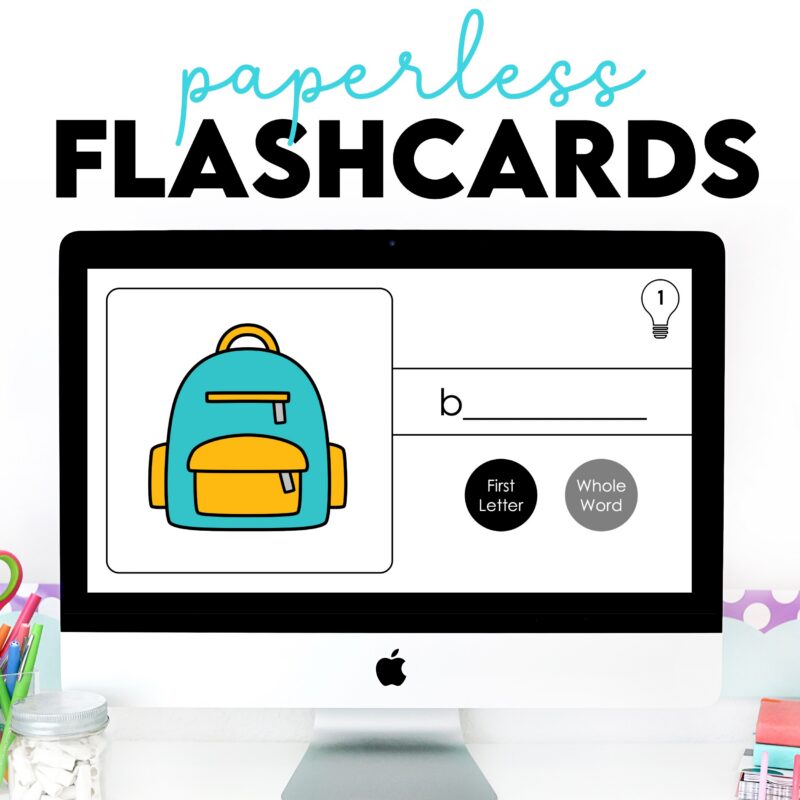
Low-Prep Vocabulary Activities That Save Teachers Time
If you want to teach vocabulary without spending hours preparing materials, the easiest solution is to use reusable vocabulary activities that work across many themes. Instead of creating a new worksheet every time you introduce school supplies, food, animals, weather, places, rooms, furniture, or community helpers, you can use print and digital vocabulary flashcards as a flexible teaching tool for whole-group lessons, speaking practice, centers, games, review, and independent vocabulary support.
Vocabulary instruction should not require teachers to spend every Sunday printing, cutting, laminating, sorting, and creating brand-new activities from scratch. Students need repeated exposure to words, visual support, opportunities to hear the words, and chances to use new vocabulary in real sentences. Teachers need activities that are easy to prep, easy to reuse, and simple enough to fit into a busy classroom routine.
That is why print and digital vocabulary flashcards are one of the most useful tools for ESL, ELL, EFL, elementary, and mixed-level classrooms. A good flashcard set can become much more than a quick word review. It can be used for whole-class instruction, partner speaking, vocabulary centers, matching games, picture dictionaries, writing prompts, listening practice, question-and-answer activities, and classroom routines.
In this post, you’ll learn how to teach vocabulary with less prep while still giving students meaningful practice. You’ll also see how different print and digital flashcard bundles can help you teach everyday vocabulary topics such as school and classroom words, food and drinks, community helpers, places in town, weather and seasons, rooms and furniture, and animals.
Why Vocabulary Lessons Often Take Too Much Prep Time
Vocabulary teaching can become time-consuming when teachers feel like they need a new activity for every word list. One week you may be teaching classroom objects. The next week you may be introducing food vocabulary. Then you might move into community helpers, places in town, weather, animals, or rooms in a house. If every unit requires a brand-new worksheet, game, center, and review activity, the prep can quickly become overwhelming.
Many teachers end up spending hours preparing materials because they are trying to create variety. Students need more than one exposure to a word, so teachers search for matching activities, writing pages, games, flashcards, cut-and-paste worksheets, picture cards, and review tasks. The problem is not vocabulary instruction itself. The problem is constantly reinventing the format.
A better approach is to reuse the same strong activity structures with different vocabulary themes. Students learn the routine once, and then you can swap in new words as the year continues. This saves prep time and helps students feel confident because they already understand how the activity works.
For example, once students know how to play a vocabulary guessing game, you can use the same structure with school supplies, food, animals, weather, community helpers, rooms, furniture, and places in town. Once students know how to use digital flashcards for “I see…” sentences, you can repeat that sentence frame with any vocabulary set.
What Makes a Vocabulary Activity Worth Preparing Once?
A strong low-prep vocabulary activity should be reusable, visual, flexible, student-friendly, and easy to differentiate. It should help students do more than memorize a list of words. Students should be able to see the word, hear the word, say the word, connect it to a picture, and eventually use it in a phrase, sentence, question, or conversation.
The best vocabulary activities usually include:
- Clear visuals that support meaning
- Simple routines students can repeat
- Opportunities for speaking and listening
- Options for whole-class, small-group, partner, or independent use
- Ways to review vocabulary over time
- Print and digital formats for different teaching situations
- Easy differentiation for beginner and more advanced learners
This is why print and digital vocabulary flashcard bundles are so useful. The digital version works well for whole-group instruction, interactive whiteboards, morning meetings, and fast review. The printable version works well for centers, matching games, partner activities, independent review, picture dictionaries, and hands-on vocabulary practice.
Why Print and Digital Flashcards Save Teachers Time
Digital flashcards are ideal when you want a no-prep vocabulary activity. You can display them on a screen, review them with the whole class, play quick vocabulary games, ask questions, or use them as a warm-up without cutting or organizing anything.
Printable flashcards are helpful when you want students to physically handle the cards, sort words into categories, play matching games, create sentences, complete centers, or work in pairs. Once printed and stored, the cards can be reused all year.
When you have both print and digital versions, you do not have to choose one teaching style. You can teach a vocabulary set digitally, then use the printable cards for extra practice. You can introduce words on the board, then move students into partner work. You can review as a whole class, then place the same vocabulary in a center.
This kind of flexible vocabulary instruction saves time because one resource can support many lesson formats.
Start the Year with School and Classroom Vocabulary
School and classroom vocabulary is one of the most practical vocabulary topics to teach at the beginning of the year. Students need these words immediately because they hear them in directions, routines, classroom conversations, and daily lessons.
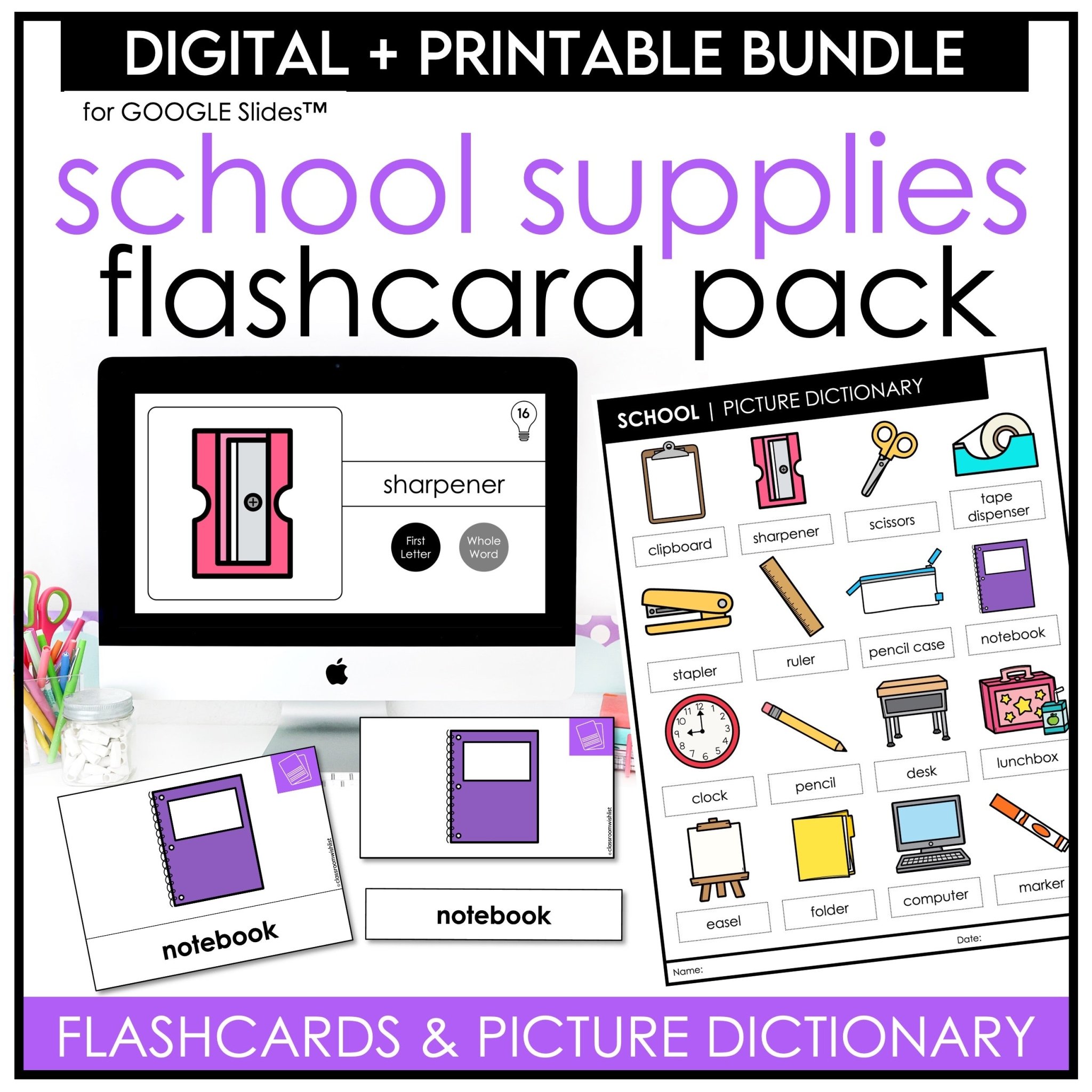
The School and Classroom Vocabulary Flashcards are useful for teaching words students need during the first weeks of school. You can use the digital flashcards to introduce classroom vocabulary to the whole group and the printable cards for centers, matching games, classroom labels, and partner review.
School vocabulary helps students understand and use words related to classroom objects, school supplies, routines, and learning spaces. This is especially helpful for newcomers and English language learners who may know academic content but need support with everyday classroom language.
Low-Prep Ways to Use School Vocabulary Flashcards
- Display one card and ask students to repeat the word.
- Ask students to find the object in the classroom.
- Use the card in a sentence: “I have a pencil.”
- Play “What’s missing?” with several cards.
- Use printable cards for a classroom object scavenger hunt.
- Have students sort supplies by category.
- Use the cards as labels around the classroom.
For beginner students, start with simple naming. For students who are ready for more language, add sentence frames such as:
- This is a ___.
- I use a ___ to ___.
- I keep my ___ in my desk.
- Can I borrow a ___?
- Where is the ___?
This turns vocabulary review into functional classroom language.
You can also find this School & Classroom Vocabulary Bundle on Teachers Pay Teachers.
Teach Food and Drinks Vocabulary with Real Conversation Practice
Food and drinks vocabulary is one of the easiest topics to turn into speaking practice because students usually have opinions. They can talk about what they like, what they do not like, what they eat for breakfast, what they order at a restaurant, what foods are healthy, and what drinks they prefer.
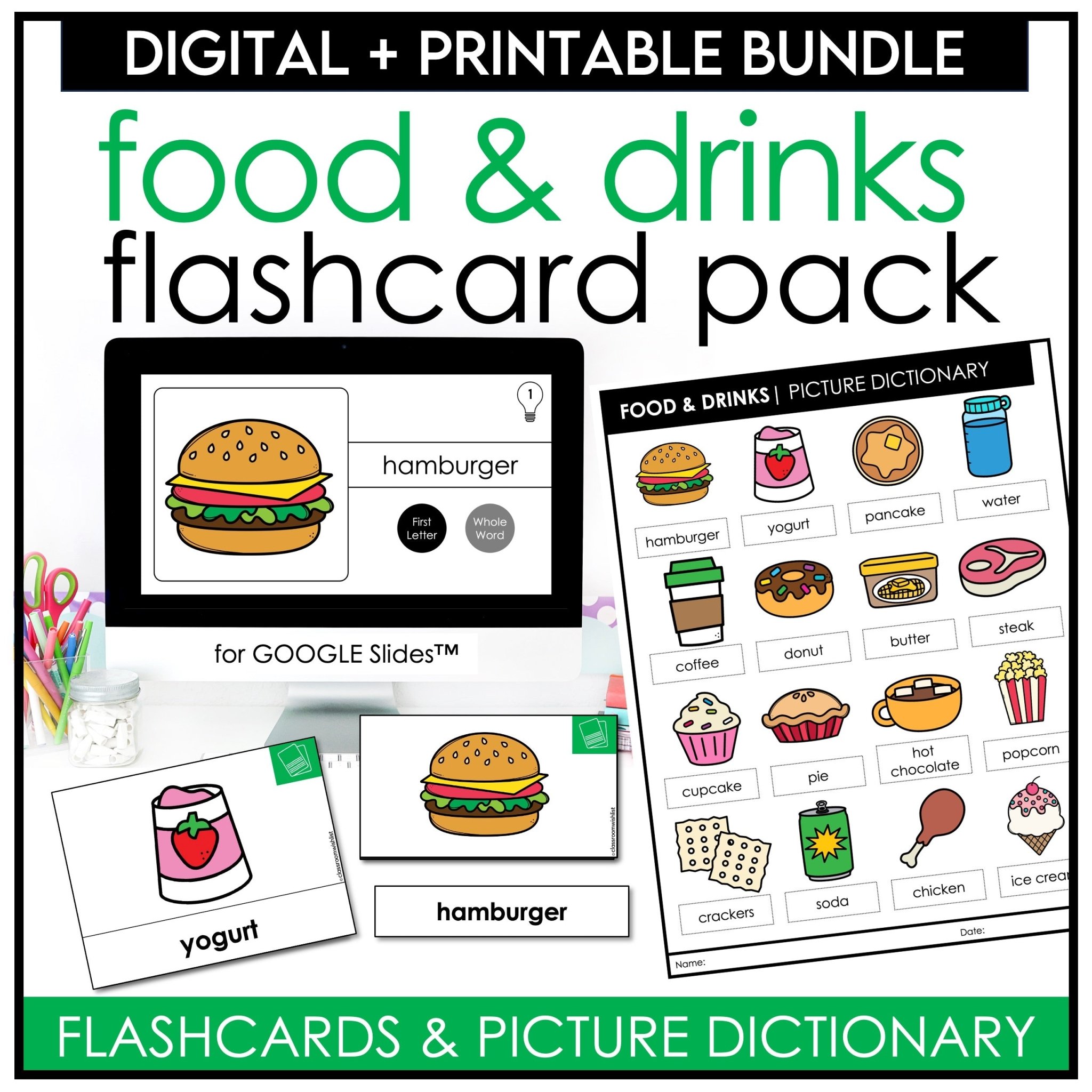
The Food and Drinks Vocabulary Flashcards make it easy to introduce and review food vocabulary in both print and digital formats. Use the digital version for whole-class practice, then use the printable cards for sorting, matching, restaurant role-plays, and partner conversations.
Food vocabulary is perfect for interactive vocabulary practice because it naturally leads to questions and answers. Students are not only memorizing words. They are using the words to communicate preferences, describe meals, compare foods, and build real-life conversation skills.
Low-Prep Food Vocabulary Activities
- Show a flashcard and ask, “Do you like ___?”
- Have students sort foods into fruits, vegetables, drinks, snacks, and meals.
- Use printable cards for a restaurant role-play.
- Ask students to create a breakfast, lunch, or dinner plate.
- Play “Would you rather eat ___ or ___?”
- Have students describe the food using adjectives.
- Use the cards for “I like / I don’t like” speaking practice.
You can make the same resource work for different levels by changing the speaking task. Beginners can say, “I like pizza.” Intermediate students can say, “I like pizza because it is cheesy.” More advanced students can compare two foods or explain which food is healthier.
Example Sentence Frames
- I like ___ because ___.
- I don’t like ___ because ___.
- For breakfast, I eat ___.
- My favorite drink is ___.
- I would rather eat ___ than ___.
- This food is sweet, salty, spicy, or sour.
These sentence frames help students move from naming vocabulary to using vocabulary in conversation.
You can also find this Food & Drinks Vocabulary Bundle on Teachers Pay Teachers.
Use Community Helpers Vocabulary for Speaking and Role-Play
Community helpers vocabulary is another high-value topic because it connects to jobs, places, tools, responsibilities, and real-world language. Students can learn the names of different helpers, describe what they do, talk about where they work, and explain why their jobs are important.
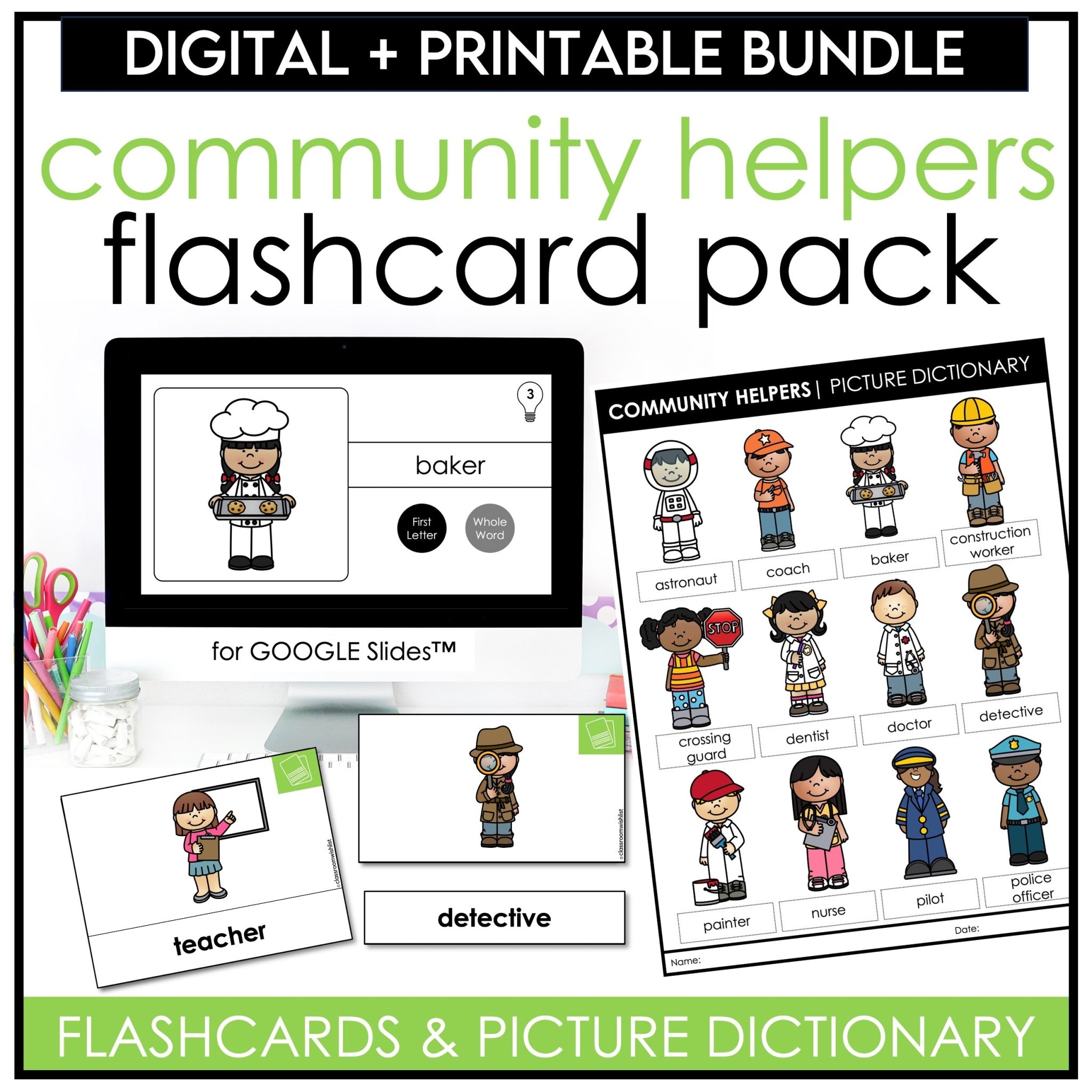
The Community Helpers Flashcard Bundle gives students visual support for learning jobs and community helper vocabulary. The print and digital format makes it easy to teach the words on a screen, then reuse the cards for sorting, guessing games, role-play, and picture dictionary practice.
Community helpers vocabulary works well because it naturally encourages complete sentences. Students can say who the person is, where they work, what they do, and what tools they use.
Low-Prep Community Helpers Activities
- Show a card and ask, “Who is this?”
- Ask students, “Where does this person work?”
- Have students match helpers to places.
- Play “Guess the job” with clues.
- Use cards for role-play interviews.
- Ask students to choose which job they would like and explain why.
- Sort jobs by indoor and outdoor work.
Community helpers are also perfect for question practice. Students can ask and answer questions such as:
- What does a doctor do?
- Where does a firefighter work?
- Who helps people at a restaurant?
- What tools does a teacher use?
- Would you like to be a police officer?
These questions help students use vocabulary in meaningful ways instead of simply naming pictures.
You can also find this Community Helpers Vocabulary Bundle on Teachers Pay Teachers.
Practice Real-Life English with Places in Town Vocabulary
Places in town vocabulary is especially useful because it connects directly to real-life communication. Students need words for locations such as school, library, hospital, restaurant, bank, park, supermarket, museum, and other city buildings. Once students know these words, they can practice asking where places are, giving directions, describing their town, and talking about where people go.
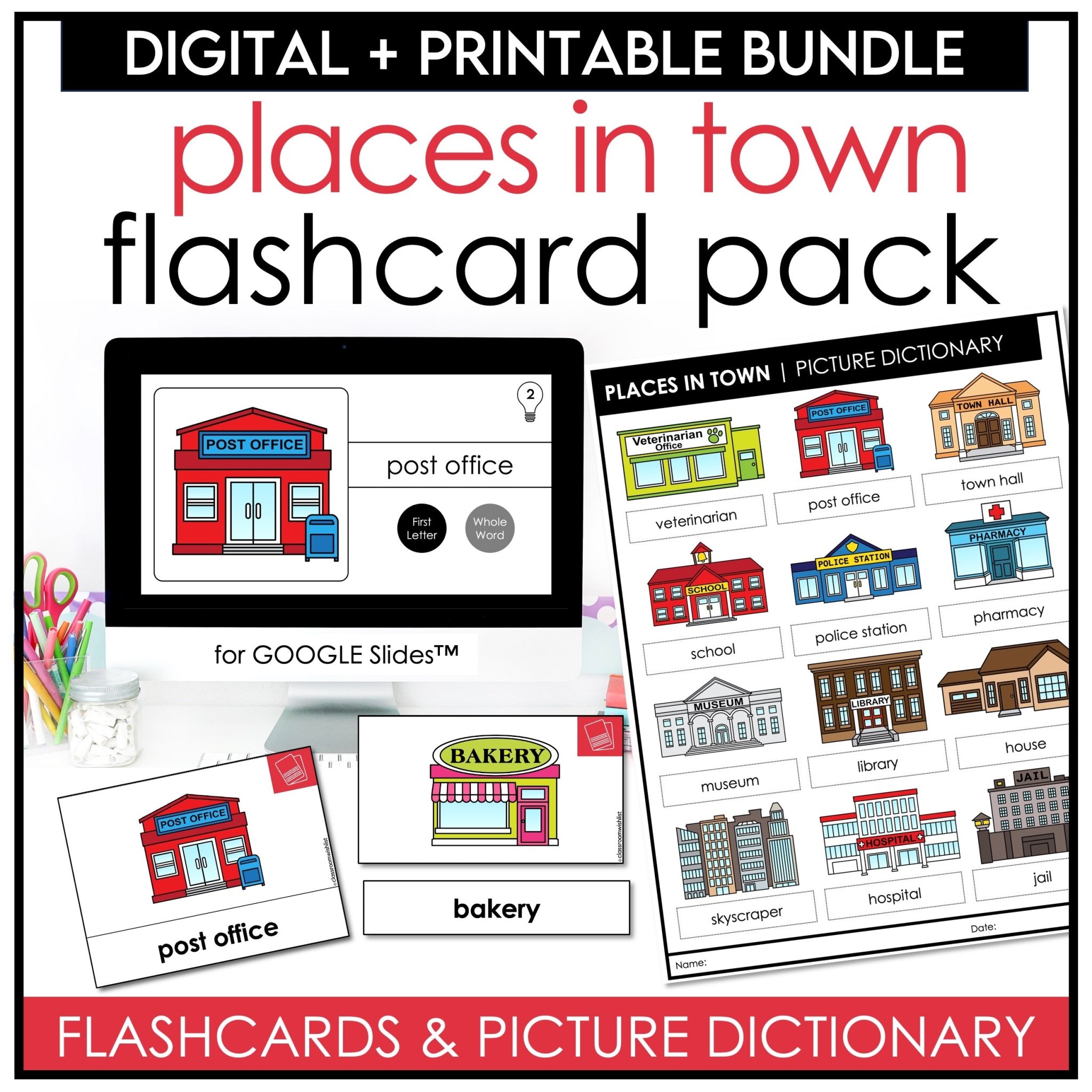
The Places in Town Vocabulary Flashcards are useful for teaching city buildings, community places, and location words. Use the digital flashcards for whole-class vocabulary instruction, then use the printable cards for map activities, direction practice, matching games, or partner speaking tasks.
This vocabulary topic is ideal for moving beyond word recognition. Once students know the words, they can practice functional language such as asking for directions, explaining where they go, and describing what people do in each place.
Low-Prep Places in Town Activities
- Show a card and ask, “What place is this?”
- Ask, “What do people do here?”
- Have students match community helpers to places.
- Use cards to create a simple town map.
- Practice “Where is the ___?” questions.
- Ask students to describe places in their town.
- Play a guessing game using clues.
For example, one student might say, “You go here when you are sick,” and another student guesses, “hospital.” Another student might say, “You can buy food here,” and classmates guess, “supermarket.” This gives students repeated vocabulary practice without needing a worksheet for every word.
Useful Sentence Frames
- I go to the ___ to ___.
- People go to the ___ when they need ___.
- The ___ is next to the ___.
- In my town, there is a ___.
- I can see a ___ near my school.
You can also find this Places in Town Vocabulary Bundle on Teachers Pay Teachers.
Make Weather and Seasons Vocabulary Part of Your Daily Routine
Weather and seasons vocabulary is perfect for daily review because it connects naturally to morning meetings, calendar time, classroom routines, and real-world conversation. Instead of teaching weather words once and moving on, you can review them every day in quick, meaningful ways.
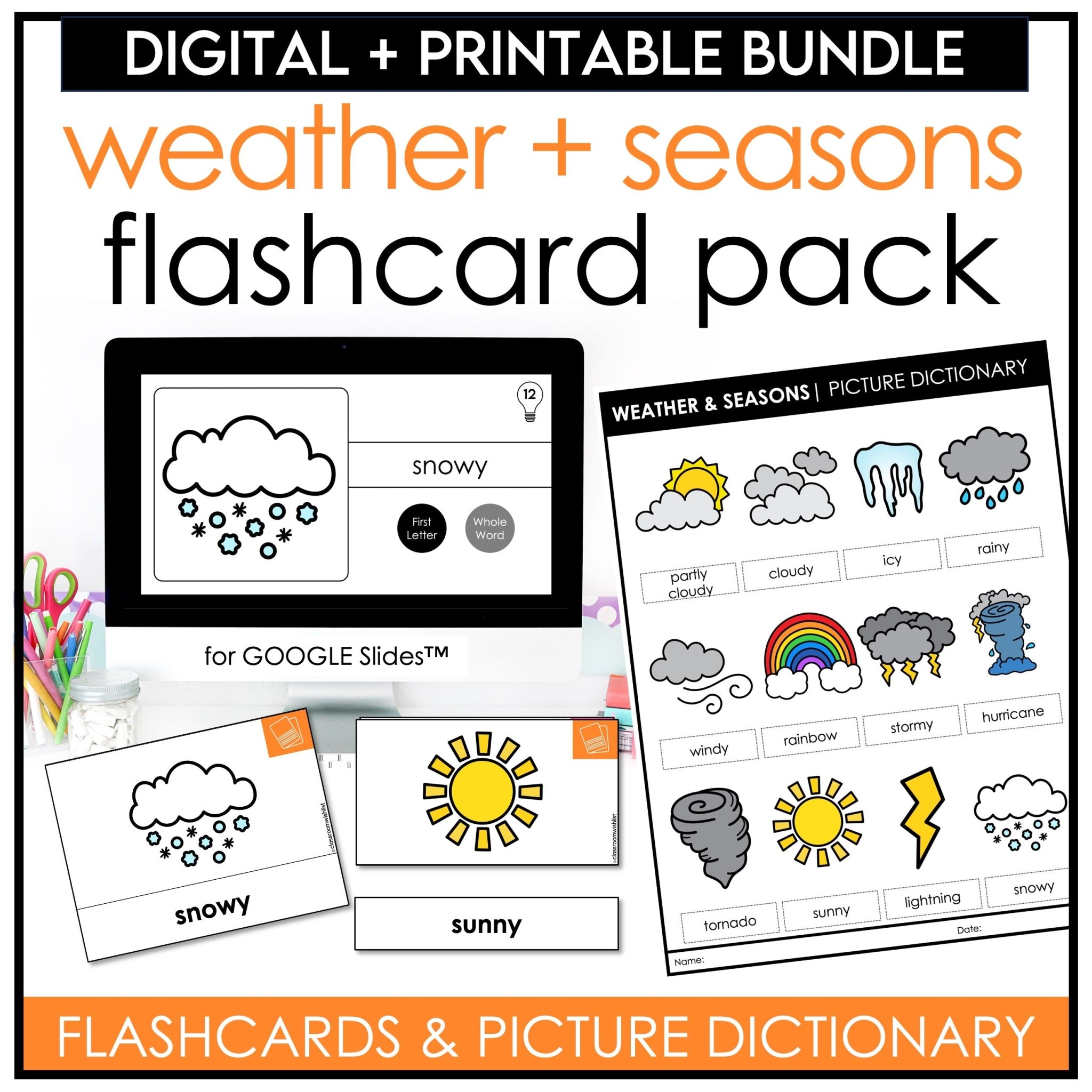
The Weather and Seasons Bundle gives teachers a simple way to build weather and seasonal vocabulary into the classroom routine. Use the digital flashcards during morning meeting or calendar time, and use the printable cards for sorting, matching, writing prompts, and partner conversations.
Weather vocabulary is useful because students can apply it immediately. They can look outside, describe the day, compare seasons, talk about favorite weather, and connect vocabulary to clothing, activities, and feelings.
Low-Prep Weather and Seasons Activities
- Ask, “What’s the weather like today?”
- Have students choose the correct weather card.
- Compare today’s weather to yesterday’s weather.
- Sort cards by season.
- Ask students what they wear in different weather.
- Use weather cards for daily sentence writing.
- Play “Guess the season” with clues.
Because the same weather words can be reviewed every day, this is one of the easiest vocabulary topics to reinforce without extra prep. Students hear and use the words repeatedly in an authentic context.
Useful Sentence Frames
- Today is ___.
- The weather is ___.
- In winter, it is usually ___.
- I wear ___ when it is ___.
- My favorite season is ___ because ___.
- I like ___ weather because ___.
This vocabulary can also lead to simple classroom discussions about seasons, holidays, clothing, activities, and daily routines.
You can also find this Weather & Seasons Vocabulary Bundle on Teachers Pay Teachers.
Bring Rooms and Furniture Vocabulary to Life
Rooms and furniture vocabulary is another practical topic because students can connect the words to their homes, classrooms, and everyday routines. Instead of only labeling pictures, students can describe rooms, explain where objects are, compare homes, and practice prepositions of place.
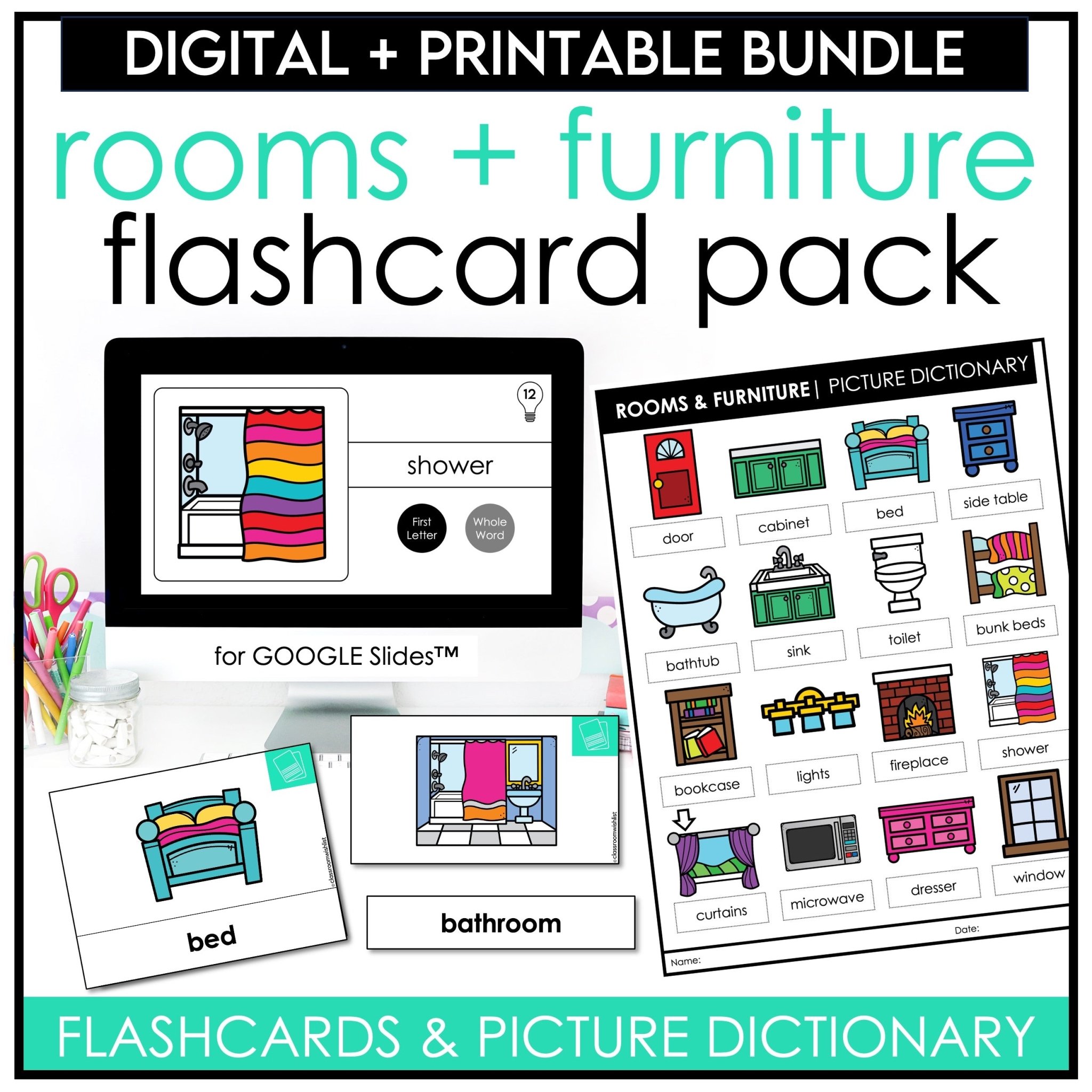
The Rooms and Furniture Vocabulary Flashcard Bundle helps students learn the names of rooms, furniture, and household objects. The digital version is useful for introducing vocabulary, while the printable cards work well for sorting activities, room design tasks, matching games, and preposition practice.
This vocabulary set is especially helpful because it connects to many grammar and speaking skills. Students can practice “there is,” “there are,” prepositions, adjectives, and simple descriptions.
Low-Prep Rooms and Furniture Activities
- Show a flashcard and ask students to name the room or object.
- Sort furniture cards by room.
- Ask students to describe their bedroom.
- Use cards to practice “There is” and “There are.”
- Have students place cards on a room map.
- Practice prepositions such as in, on, under, next to, and between.
- Ask students to design a dream room using vocabulary cards.
Useful Sentence Frames
- There is a ___ in the ___.
- There are ___ in the ___.
- The ___ is next to the ___.
- My bedroom has a ___.
- I use a ___ in the ___.
- My favorite room is ___ because ___.
Because students can connect this vocabulary to their own lives, it naturally supports speaking and writing practice. After reviewing flashcards, students can describe a room, draw and label a house, or ask a partner questions about their home.
You can also find this Rooms & Furniture Vocabulary Bundle on Teachers Pay Teachers.
Teach Animal Vocabulary with Games, Guessing, and Descriptions
Animal vocabulary is usually highly engaging for young learners and elementary ESL students. Students enjoy talking about pets, zoo animals, farm animals, animal sounds, habitats, and favorite animals. Animal vocabulary is also easy to extend into describing, comparing, guessing, and categorizing activities.
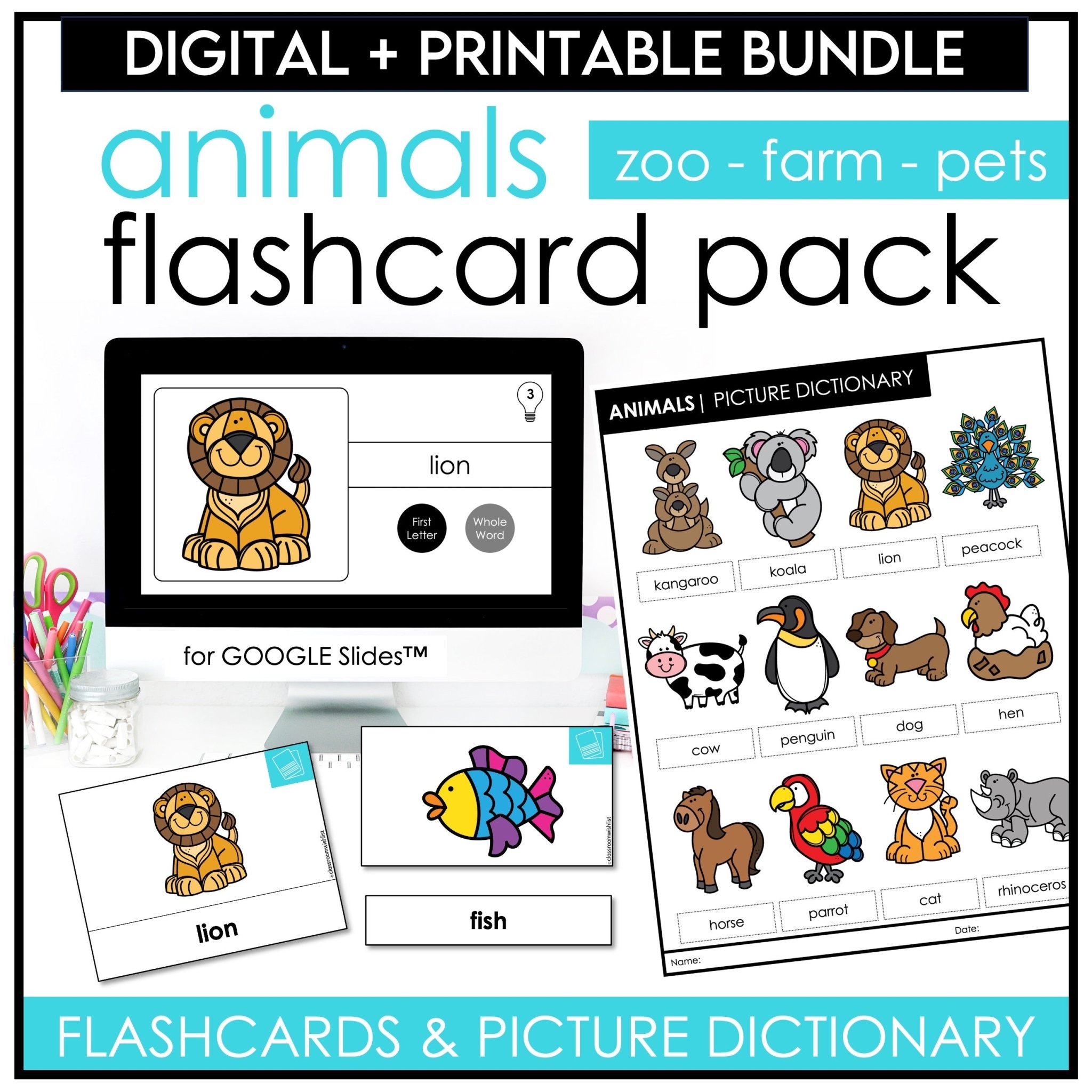
The Animals Flashcard Bundle includes vocabulary for zoo animals, farm animals, and pets. Use the digital flashcards for whole-group vocabulary instruction and the printable cards for sorting, matching, animal guessing games, writing prompts, and speaking centers.
Animals are especially useful for descriptive language. Students can talk about size, color, habitat, movement, food, and abilities. This helps students move from single-word answers to more complete sentences.
Low-Prep Animal Vocabulary Activities
- Sort animals into pets, farm animals, and zoo animals.
- Play “Guess my animal” using clues.
- Ask students to describe an animal without naming it.
- Compare two animals using adjectives.
- Ask students to choose their favorite animal and explain why.
- Use printable cards for matching games.
- Have students create animal riddles.
Useful Sentence Frames
- It is a ___.
- It has ___.
- It can ___.
- It lives in ___.
- It eats ___.
- My favorite animal is ___ because ___.
- A ___ is bigger than a ___.
Animal vocabulary is also a great way to practice comparisons. Students can compare a lion and a cat, a dog and a wolf, a horse and a cow, or a bird and a fish. These comparison activities help students use vocabulary in more complex ways.
You can also find this Animals Vocabulary Bundle on Teachers Pay Teachers.
How to Reuse the Same Vocabulary Activities All Year
The secret to saving prep time is not finding a completely new activity every week. The secret is using strong routines that work with many vocabulary topics. Once students learn the activity format, you can reuse it again and again with new vocabulary sets.
Here are reusable vocabulary routines that work with nearly any flashcard bundle.
1. Name It
Show a card and have students name the word. This works well for first exposure and quick review.
2. Use It in a Sentence
Students say or write a sentence using the vocabulary word.
3. Sort It
Students sort cards into categories such as food groups, rooms, animals, places, jobs, or seasons.
4. Guess It
One student gives clues while classmates guess the word.
5. Find It
Students find the object in the classroom, in a picture, or on a printed card set.
6. Compare It
Students compare two vocabulary cards using adjectives or sentence frames.
7. Ask About It
Students ask a partner a question related to the word.
8. Write About It
Students use the word in a short sentence, description, or mini paragraph.
These simple routines can be used with school vocabulary, food vocabulary, community helpers, places in town, weather, rooms and furniture, animals, and many other vocabulary themes.
Create a Vocabulary Center You Can Use All Year
One of the easiest ways to reduce prep time is to create a vocabulary center that keeps the same structure all year. Instead of changing the whole center every week, you only change the vocabulary cards. This gives students variety without creating extra work for you.
A simple vocabulary center might include:
- A set of printable flashcards
- A matching activity
- A sentence frame card
- A recording sheet
- A sorting mat
- A partner speaking prompt
Once students understand how the center works, you can use it with any vocabulary set. One week students may work with food and drinks. Another week they may work with places in town. Later, they can use the same center structure for animals, rooms, furniture, weather, or community helpers.
Example Vocabulary Center Routine
- Students choose a flashcard.
- They say the word aloud.
- They match the word to a picture or category.
- They use the word in a sentence.
- They ask a partner a question about the word.
- They write one sentence on a recording sheet.
This routine gives students listening, speaking, reading, and writing practice without requiring a brand-new activity every week.
How to Differentiate Vocabulary Activities Without Extra Prep
Reusable vocabulary flashcards make differentiation easier because all students can work with the same visual support while producing language at different levels.
For Beginner Students
- Name the picture.
- Repeat the word.
- Point to the correct card.
- Match picture to word.
- Use a simple sentence frame.
Example: “It is a dog.”
For Intermediate Students
- Describe the picture.
- Use the word in a sentence.
- Ask and answer questions.
- Compare two cards.
- Sort cards into categories and explain why.
Example: “A dog is a pet. It can run and play.”
For Advanced Students
- Give detailed descriptions.
- Create riddles.
- Explain opinions.
- Compare and contrast vocabulary words.
- Use the words in short stories or conversations.
Example: “I think a dog is easier to care for than a horse because it is smaller and can live inside a house.”
This type of differentiation helps every student participate without requiring you to prepare three completely different activities.
A Simple Weekly Vocabulary Plan for Busy Teachers
If you want to teach vocabulary consistently without spending hours preparing materials, try using a predictable weekly routine. Students benefit from repetition, and you benefit from a planning structure you can use again and again.
| Day | Activity | Purpose |
|---|---|---|
| Monday | Introduce digital flashcards | Students see and hear the new words. |
| Tuesday | Play a quick guessing game | Students retrieve words from memory. |
| Wednesday | Use printable cards in centers | Students match, sort, and review vocabulary. |
| Thursday | Partner speaking practice | Students use words in questions and answers. |
| Friday | Writing or review game | Students apply vocabulary independently. |
This schedule works with nearly any vocabulary topic. You can use it with school vocabulary, food and drinks, community helpers, places in town, weather and seasons, rooms and furniture, or animals.
Why Students Remember More with Repeated Vocabulary Routines
Students need repeated exposure to new vocabulary before they can use words confidently. Seeing a word once is rarely enough. Students need to hear it, say it, connect it to a picture, use it in a sentence, and revisit it over time.
Reusable flashcard activities make this easier because they give students repeated practice without making the lesson feel repetitive. The structure stays familiar, but the words and tasks can change.
For example, students can play “Guess the Word” with food vocabulary one week and animal vocabulary the next. They already know the game, so they can focus on the language. This saves explanation time and increases student confidence.
Common Vocabulary Teaching Mistakes to Avoid
Using Word Lists Without Visual Support
Many students, especially English language learners, need visuals to understand and remember new words. Flashcards and picture dictionaries give students a clear connection between the word and meaning.
Teaching Too Many Words at Once
It is better to teach a smaller set of words well than to rush through a long list that students forget. Use repeated review and meaningful practice.
Only Asking Students to Memorize Definitions
Students need to use vocabulary, not just memorize it. Add speaking, sorting, describing, and writing tasks.
Creating New Activities Every Week
You do not need to reinvent vocabulary instruction for every unit. Use reusable routines and swap the vocabulary theme.
Skipping Review
Vocabulary needs to be reviewed regularly. Digital flashcards make quick review easy during transitions, warm-ups, and morning meetings.
Final Thoughts
Teaching vocabulary should not require hours of preparation every week. With the right reusable resources, you can give students meaningful vocabulary practice while saving yourself time.
Print and digital flashcard bundles are especially useful because they support many teaching formats. Use the digital version for whole-class instruction, interactive whiteboard lessons, quick review, and morning meetings. Use the printable version for centers, matching games, sorting activities, partner practice, picture dictionaries, and independent review.
Instead of creating new worksheets for every vocabulary topic, build a collection of reusable vocabulary routines that students can use all year. When students know how to name, sort, describe, compare, guess, ask, answer, and write about vocabulary words, they become more confident language users.
Whether you are teaching school vocabulary, food and drinks, community helpers, places in town, weather and seasons, rooms and furniture, or animals, the goal is the same: help students understand new words and use them in meaningful ways.
Your future teacher self will thank you for choosing vocabulary activities that are flexible, reusable, and easy to prep.
Frequently Asked Questions About Low-Prep Vocabulary Activities
How can I teach vocabulary without spending hours preparing materials?
Use reusable activities such as digital flashcards, printable flashcards, sorting games, matching activities, guessing games, and sentence frames. Once students learn the routine, you can use it with many vocabulary themes.
Are digital flashcards good for ESL students?
Yes. Digital flashcards are helpful for ESL students because they provide visual support, clear vocabulary presentation, and easy whole-class review without extra prep.
Should I use printable or digital flashcards?
Both are useful. Digital flashcards work well for whole-class instruction and quick review. Printable flashcards are great for centers, matching games, partner activities, sorting, and hands-on practice.
How often should students review vocabulary?
Students benefit from reviewing vocabulary several times throughout the week. Short, repeated practice is often more effective than one long vocabulary lesson.
What are the best low-prep vocabulary activities?
Some of the best low-prep vocabulary activities include flashcard review, matching games, picture sorting, “Guess the Word,” partner questions, sentence frames, and vocabulary centers.
How do I make vocabulary practice more interactive?
Add speaking, movement, choice, and partner tasks. Ask students to describe pictures, answer questions, sort words, give clues, compare cards, or use words in sentences.
How can I differentiate vocabulary practice?
Beginners can name and match pictures. Intermediate students can use sentence frames. Advanced students can explain, compare, describe, and create original sentences or stories.
Why do students forget vocabulary quickly?
Students often forget vocabulary when they only see words once or memorize them without using them. Repeated exposure and meaningful use help students remember new words.
Can vocabulary flashcards be used for speaking practice?
Yes. Flashcards can be used for partner questions, guessing games, descriptions, comparisons, role-play, and sentence building.
What vocabulary topics should I teach first?
Start with practical topics students need right away, such as classroom vocabulary, food, weather, animals, places in town, rooms, furniture, and community helpers.
How can I use flashcards in centers?
Students can match word and picture cards, sort by category, write sentences, describe cards to a partner, or play a guessing game.
Are print and digital bundles worth using?
Yes. Print and digital bundles give teachers more flexibility. You can teach vocabulary digitally, then reinforce it with printable cards in centers, small groups, or independent practice.
You Might Also Like
- First Week of School Icebreaker Activities Students Will Love
- From Worksheets to Real Conversations: Why Speaking Games Work
- Halloween ESL Activities Students Actually Want to Play
- How to Use Boom Cards for Summer Grammar Practice
- How to Teach Beginning Blends with Phonics Games
