


How to Teach CVC Word Families with an Interactive Phonics Word Wall
CVC word families help beginning readers recognize short-vowel spelling patterns, blend words more efficiently, and apply familiar patterns to new words. Instead of approaching every CVC word as an entirely new decoding challenge, students learn to notice which letters stay the same and which sound changes.
A well-organized CVC word wall makes these patterns visible throughout the school day. Students can use it during explicit phonics instruction, literacy centers, small-group reading, intervention, spelling practice, and independent writing.
However, a CVC word wall should be more than classroom decoration. It becomes most effective when teachers introduce the word families gradually, model how to use the display, and return to it during meaningful reading and writing activities.
In this guide, I am sharing the routines, activities, and teaching strategies I use to introduce CVC word families to kindergarten, first-grade, ESL, and ELL students. You will also find practical ideas for using printable posters, visual references, word-family games, and short daily phonics routines.
The Classroom Moment That Inspired These CVC Word Family Posters
The idea for these CVC word family posters began during a small-group reading lesson with several beginning readers, including English language learners.
We had spent the morning practicing the -at word family. With support, the students could decode the word cat. However, when I replaced the first letter and showed them hat, several students began the entire decoding process again as though they had never seen the spelling pattern before.
One student tried to guess the word from the picture. Another waited quietly for me to provide the answer. They knew many of the individual letter sounds, but they were not yet recognizing the relationship between the words.
I wrote -at inside a colored box and placed the beginning consonants C, H, M, and R beside it.
I asked, “What stays the same in every word?”
After a pause, one student pointed to the boxed ending. We slowly moved each beginning consonant toward -at and blended the words:
- c-at
- h-at
- m-at
- r-at
The activity was simple, but it gave the students something visible to hold onto. They could see that the beginning sound changed while the vowel and final consonant stayed the same.
That afternoon, I created a few basic word-family cards and taped them to the wall beside our reading table. Over the next several days, I added the -an and -ap families.
The moment that stayed with me happened during writing time. One student wanted to spell map. Instead of asking me for the answer, the student walked to the wall, found the -ap family, and changed the beginning sound independently.
The student no longer treated map as a completely unfamiliar word. A known spelling pattern had become a tool for solving a new word.
I began redesigning those homemade cards into coordinated word-family headers and illustrated CVC word posters. I wanted the display to support vocabulary without teaching students to guess from pictures, so I developed a consistent routine:
- Look at the letters.
- Say the individual sounds.
- Blend the complete word.
- Use the picture to confirm the meaning.
I also created black-and-white versions that students could keep in phonics folders, interactive notebooks, or take-home practice sets.
As we continued using the display, I noticed meaningful changes. Students began pointing to the short vowel and word-family ending before asking for help. They became more willing to attempt unfamiliar words and more likely to correct themselves when a word did not sound right.
The word wall was especially helpful for quieter students. They no longer needed to announce to the group that they were stuck. They could check the display independently and return to their work with more confidence.
No poster can replace explicit, systematic phonics instruction. The improvement did not happen after one lesson. It came from combining a clear visual reference with daily blending, comparison, spelling, rereading, and application.
That classroom routine became the foundation for the CVC Word Family Posters—a printable resource designed to give beginning readers a clear and accessible short-vowel reference.

See the CVC Word Family Posters →
What Are CVC Words?
A CVC word follows a consonant-vowel-consonant spelling pattern. Examples include:
- cat
- bed
- pig
- hot
- sun
In a typical CVC word, the middle vowel represents its short-vowel sound. Students read the word by identifying each sound and blending from left to right.
For example:
m + a + p = map
CVC words are often among the first decodable words students learn because they contain a straightforward sound-spelling pattern. They allow beginning readers to practice phonemic awareness, letter-sound correspondence, blending, segmenting, spelling, and early reading fluency.
What Are CVC Word Families?
A CVC word family is a group of words that share the same vowel and final consonant. The beginning consonant changes, but the ending pattern remains consistent.
For example, the -at word family includes:
- bat
- cat
- hat
- mat
- rat
- sat
Each word contains a different beginning sound, but all the words share the -at spelling pattern.
Common short-vowel CVC word families include:
- Short A: -ad, -ag, -am, -an, -ap, -at
- Short E: -ed, -en, -et
- Short I: -ig, -in, -ip, -it, -ix
- Short O: -ob, -og, -op, -ot, -ox
- Short U: -ub, -ug, -un, -ut
Word families give students an organized way to compare similar words. Once students recognize a familiar ending, they can focus their attention on the beginning consonant while still reading the complete word.
However, students should not memorize word families as unanalyzed chunks. They still need to look through the entire word, connect each letter to its sound, and blend from left to right.
Why CVC Word Families Help Beginning Readers
Beginning readers must coordinate several skills at the same time. They need to remember the beginning consonant, identify the short-vowel sound, notice the final consonant, blend the sounds, and connect the completed word to meaning.
For some students, this process requires a great deal of working memory. A visual word-family display reduces the need to remember every example independently.
CVC word-family practice can help students:
- Recognize recurring short-vowel spelling patterns
- Notice which letters stay the same
- Compare words with different beginning sounds
- Distinguish between short-vowel sounds
- Blend words with greater accuracy
- Apply familiar patterns to unfamiliar words
- Connect spoken words to printed words
- Use known patterns during spelling and writing
- Develop confidence before reading more complex words
Word-family instruction can also make phonics patterns easier to discuss. Instead of presenting unrelated lists of words, teachers can ask students to compare the words and explain exactly what changes.
Why Visual Word-Family Displays Are Helpful
A visual display gives students a consistent reference they can revisit throughout the day. Rather than waiting for the teacher to provide a word, students can use the wall to check a vowel sound, compare spelling patterns, or find a similar word.
A useful CVC word wall can help students:
- Identify short-vowel patterns
- Compare neighboring words
- Review previously taught families
- Check spelling during writing
- Reread familiar words independently
- Connect illustrations to unfamiliar vocabulary
- Find a starting point when they are unsure how to decode a word
Visual support can be particularly valuable for ESL and ELL students, who may be learning a word’s pronunciation, spelling, and meaning at the same time.
Pictures provide helpful vocabulary support, but they should not become a replacement for decoding. I teach students to read the letters first and use the illustration only to confirm that the word makes sense.
A CVC Word Wall Should Be a Teaching Tool, Not Just Decoration
One lesson I learned early in my teaching career is that a word wall only becomes valuable when students are taught how to use it.
If every poster is displayed at the beginning of the year and never discussed again, the words can quickly blend into the classroom background. Students may notice the colors and pictures without understanding how the display can support their reading.
A more effective approach is to build the word wall gradually, following the same sequence as your phonics instruction.
Add One Word Family at a Time
Begin with a familiar and productive family such as -at, -an, or -ig. Display the family header with three or four illustrated examples.
Read the words together and ask students to identify what stays the same.
Highlight the Shared Spelling Pattern
Use a box, underline, pointer, or hand motion to draw attention to the word-family ending.
For example, in the word map, students can first identify the beginning sound /m/ and then blend it with /ap/.
Compare Related Words
Place two words from the same family beside each other, such as cat and hat.
Ask:
- Which letters are the same?
- Which letter changed?
- What sound does the new beginning letter represent?
- How does that change the word?
- Can you read both words?
Refer to the Wall During Reading
When a familiar pattern appears in a decodable sentence or book, connect it to the word wall.
You might say, “This word ends with -at. Where have we seen that pattern before?”
Use the Display During Writing
Encourage students to check the word wall before asking how to spell a CVC word.
A student who wants to write fan may find the -an family, locate a similar word, and replace the beginning consonant.
This teaches students that the display is not limited to phonics lessons. It is a practical reference for reading and writing.
A Simple Routine for Introducing a New CVC Word Family
This gradual-release routine keeps the phonics target clear while giving students several opportunities to hear, see, read, and use the pattern.
- Say the family ending. Introduce the shared spelling pattern, such as -at.
- Listen for the vowel. Stretch the ending slightly and identify the short-vowel sound.
- Build one complete word. Add a beginning consonant and blend from left to right.
- Compare several examples. Read three or four words that share the same ending.
- Discuss meaning. Use each word in a short sentence or briefly discuss its illustration.
- Add the family to the word wall. Display the header and selected word posters.
- Review the pattern throughout the week. Revisit it during reading, spelling, writing, and literacy centers.
For example, when introducing the -ig family, you might begin with pig.
Students identify the sounds:
/p/ /i/ /g/
Then they blend the word and compare it with other examples:
- big
- dig
- fig
- wig
The important part is not simply reading a rhyming list. Students should notice the letter-sound relationships and understand how changing the first letter creates a new word.

Explore all 114 printable CVC word family posters →
Seven Practical CVC Word Wall Activities
A CVC word wall becomes more useful when students interact with it regularly. These activities require very little preparation and can be used during whole-group phonics, small groups, literacy centers, morning work, or classroom transitions.
1. Point, Blend, and Read
Choose one word family and point to three or four words. Students identify the beginning sound, say the word-family ending, and blend the complete word.
For example:
- /m/ + /at/ = mat
- /r/ + /at/ = rat
- /s/ + /at/ = sat
Keep this activity brief. A two-minute review can be an effective way to revisit a pattern without turning it into a lengthy lesson.
2. Find the Word Family
Say a CVC word aloud and ask students to locate its word family on the wall.
For example, say pig and ask students to find the -ig family. Once they locate it, read the other words in that family together.
This activity connects listening, phonemic awareness, and visual pattern recognition.
3. Change the Beginning Sound
Display or point to a familiar word such as cat.
Say, “Change /c/ to /h/. What is the new word?”
Students replace the first sound and read hat. Continue with additional beginning consonants.
You can also use magnetic letters, letter cards, or dry-erase boards to make the sound substitution more hands-on.
4. Sort Words by Short Vowel
Give students a set of CVC word cards and ask them to sort the words under:
- Short A
- Short E
- Short I
- Short O
- Short U
Once students can distinguish the vowel categories, ask them to sort by specific word family.
For example, short-A words might be divided into -at, -an, -ap, and -ag.
5. Complete a Word-Family Hunt
During shared reading or decodable-text practice, ask students to search for words that match a family displayed on the wall.
Students can record the words on a class chart, sticky note, or whiteboard.
This helps students recognize that the same phonics patterns appear in authentic reading—not only on isolated flashcards.
6. Read, Cover, Spell, and Check
Ask students to choose one word from the wall and complete the following steps:
- Read the word.
- Cover the poster.
- Spell the word on a whiteboard or piece of paper.
- Uncover the poster.
- Check and correct the spelling.
This activity connects decoding with encoding. Students are not only reading the spelling pattern; they are also using it to produce the word independently.
7. Build a Sentence
Select one CVC word and use it in a short sentence.
Beginning writers can use a sentence frame such as:
I see a ______.
More confident students can write their own sentence and underline or highlight the target CVC word.
Ask students to reread the sentence after writing it. This gives the word-family pattern a meaningful context.
How to Use the Printable CVC Word Family Posters
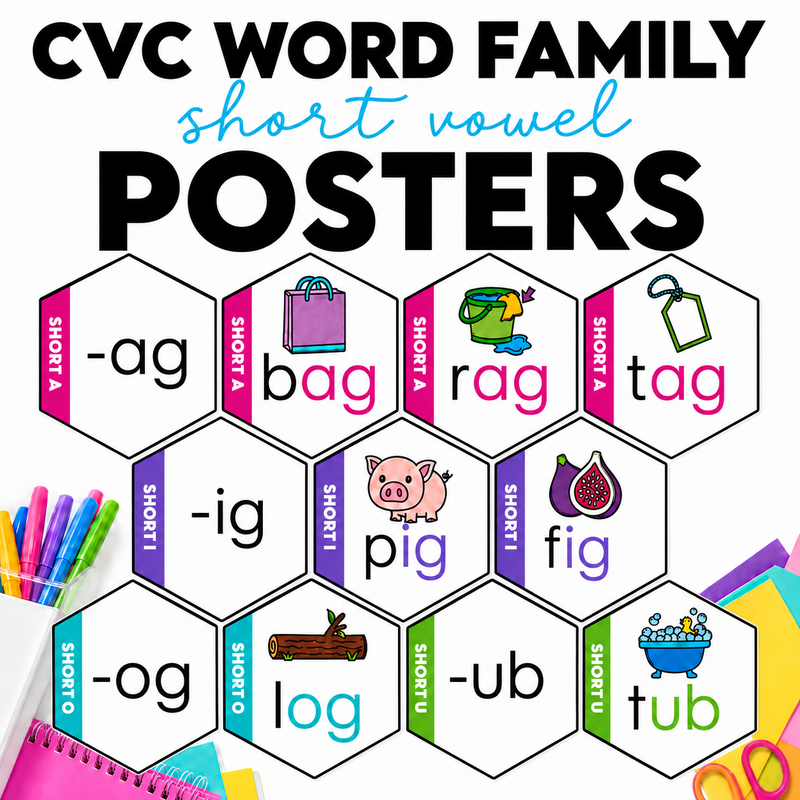
The CVC Word Family Posters include 114 printable phonics posters covering 23 short-vowel word families.
Each coordinated family includes a word-family header and illustrated CVC word posters. This makes it easy to introduce one pattern at a time and build the word wall gradually as students progress through short-vowel instruction.
The resource includes:
- 23 short-vowel word-family headers
- 114 illustrated CVC word posters
- Full-color versions
- Black-and-white ink-saving versions
- Approximately 7 × 7-inch posters
The posters can be used for:
- Classroom phonics displays
- CVC word walls
- Bulletin boards
- Small-group reading areas
- Literacy centers
- Reading intervention
- Student phonics folders
- Interactive notebooks
- Take-home practice
Ways to Use the Full-Color Posters
- Create a permanent or rotating classroom word wall.
- Display the current phonics pattern near your small-group table.
- Use the posters as a visual reference in a literacy center.
- Place selected families on a bulletin board for cumulative review.
Ways to Use the Black-and-White Posters
- Create individual student reference sets.
- Add the pages to interactive phonics notebooks.
- Send selected families home for additional practice.
- Use the pages during intervention or tutoring.
- Allow students to color the pictures after decoding the words.
Students do not need to see every family at the same time. Introduce only the patterns they are ready to use, and add new posters as your phonics sequence progresses.

View the color and ink-saving CVC poster set →
How to Differentiate CVC Word-Family Practice
Students rarely need the exact same amount or type of support. You can differentiate word-family practice by changing the number of patterns presented, the amount of picture support, the complexity of the words, and the required response.
For Students Beginning CVC Instruction
- Teach one short vowel at a time.
- Introduce one word family during each lesson.
- Begin with two or three familiar words.
- Model how to point under each letter.
- Use continuous blending whenever possible.
- Ask students to use the picture only after decoding.
At this stage, accuracy is more important than speed. Give students enough time to attend to each sound.
For ESL and ELL Students
- Preteach unfamiliar picture vocabulary.
- Connect each word to a real object, action, gesture, or simple sentence.
- Model clear pronunciation without artificially stretching the vowel.
- Allow students to repeat words chorally before reading independently.
- Use predictable speaking frames.
- Review the difference between similar short-vowel sounds.
Helpful speaking frames include:
- “The word is ______.”
- “I see the word ______.”
- “______ belongs to the ______ family.”
- “The beginning sound is ______.”
Some illustrated words may be easy to decode but unfamiliar in meaning. Brief vocabulary instruction ensures that students develop decoding and language comprehension together.
For Developing Readers
- Mix two or more short-vowel families.
- Ask students to explain how the patterns are different.
- Remove picture support during selected activities.
- Include spelling and sentence-writing tasks.
- Add unfamiliar but decodable words to check transfer.
- Ask students to find mistakes and correct them.
For Intervention and RTI
- Use smaller word sets.
- Provide more frequent cumulative review.
- Track which short-vowel sounds are confused.
- Practice accurate blending before increasing speed.
- Use manipulatives to build and change words.
- Include immediate corrective feedback.
- Celebrate careful reading and self-correction.
During intervention, it can be helpful to compare only two vowel sounds at a time. For example, students who confuse short A and short I may sort and read words from the -at and -it families.
My 10-Minute CVC Word-Family Routine
You do not need an entire reading block to practice CVC word families. A short, consistent routine can provide focused review without overwhelming students.
Minutes 1–2: Oral Blending
Say three segmented CVC words without showing the print.
For example:
- /m/ /a/ /p/
- /s/ /a/ /t/
- /p/ /i/ /g/
Students blend the sounds orally and say the complete words.
Minutes 3–4: Introduce or Review the Family
Display the word-family header. Identify the vowel sound and read one example together.
Ask students to explain which letters form the shared ending.
Minutes 5–7: Read and Compare
Read three or four words from the same family. Discuss which letters remain the same and which beginning consonant changes.
Ask students to read the words in a different order so they attend to the print rather than memorizing the sequence.
Minutes 8–9: Apply the Pattern
Choose one brief application task:
- Sort a word card.
- Build a word with magnetic letters.
- Spell a word on a whiteboard.
- Find the word family in a sentence.
- Change the beginning sound.
Minute 10: Quick Review
Ask each student to read one familiar word and one new word from the same family.
Make a quick note of who reads independently, who confuses the vowel, and who needs additional blending support.
Common CVC Word-Family Teaching Mistakes
Word families can be extremely useful, but the way they are introduced matters. These are some of the most common mistakes I have learned to avoid.
Displaying Every Word Family at Once
A wall covered with dozens of unfamiliar words can be difficult for beginning readers to navigate. Too much visual information may prevent students from finding the pattern they need.
Build the display in the same sequence as your phonics instruction and review earlier families regularly.
Allowing Pictures to Replace Decoding
Illustrations can support vocabulary, but students may begin guessing when pictures are too prominent or when they are not expected to attend to the letters.
Use a consistent prompt:
“Read the letters first. Then check the picture.”
Teaching Word Families Only as Rhyming Lists
Rhyming can help students hear similarities, but students should not simply memorize a chant such as “cat, hat, mat, rat.”
Continue asking them to identify the individual sounds, notice the letters, and blend from left to right.
Focusing on Speed Before Accuracy
Fast guessing is not reading fluency. A student who quickly guesses cat when the word is cap is not yet attending carefully to the complete word.
Praise students for:
- Checking every letter
- Producing the correct vowel sound
- Blending carefully
- Rereading the word
- Recognizing and correcting an error
Using the Word Wall Only During Phonics Lessons
Students need to see that phonics patterns are useful across different contexts. Refer to the display during:
- Decodable reading
- Independent writing
- Spelling activities
- Literacy centers
- Small-group intervention
- Morning review
Assuming Students Know the Picture Vocabulary
A student may decode a word correctly without knowing what it means. This is particularly important for English language learners.
Briefly explain unfamiliar words, show a real object when possible, or use the word in a simple sentence.
How to Pair Visual Support with Hands-On CVC Practice
In my classroom, posters make the spelling patterns visible, while games give students repeated opportunities to apply those patterns.
After introducing a word family, move the same phonics target into a partner game, sorting activity, board game, or spelling center.
This creates a clear instructional sequence:
- Students hear the sounds.
- Students see the spelling pattern.
- Students blend the words.
- Students compare related words.
- Students apply the pattern during a hands-on activity.
- Students use the pattern during reading and writing.
You can extend CVC word-family instruction with these resources:
- Use the CVC Word Board Game Bundle to combine decoding, spelling, and writing practice.
- Use the CVC Short-Vowel Card Games Bundle for repeated decoding practice with different levels of picture support.
- Browse the complete CVC and CVCe Phonics Resources Collection for additional short-vowel and early-reading activities.
The visual reference and hands-on activity should reinforce the same phonics skill. Students first notice the pattern on the wall and then apply it while reading, matching, sorting, building, spelling, or playing.
How to Assess CVC Word-Family Progress
You do not always need a formal assessment to learn how students are progressing. Some of the most useful information comes from observing students during everyday reading and writing routines.
As students work, make brief notes about:
- Short-vowel sounds identified accurately
- Words blended independently
- Beginning sounds omitted or replaced
- Final sounds omitted
- Confusion between similar vowels
- Reliance on picture guessing
- Ability to compare related words
- Self-correction after checking the letters
- Transfer to unfamiliar CVC words
- Use of word-family patterns during spelling
- Independent use of the word wall
Check for Transfer
To determine whether a student understands a word-family pattern, include a decodable word that has not been practiced repeatedly.
For example, after practicing cat, hat, mat, and rat, ask the student to read sat.
A student who understands the -at pattern should be able to approach the unfamiliar example by identifying the new beginning consonant and blending the complete word.
Check Both Reading and Spelling
A student may recognize a word while reading but still have difficulty segmenting and spelling it.
Ask students to:
- Read a CVC word.
- Say each sound.
- Build it with letters.
- Write it independently.
- Use it in a sentence.
This gives you a more complete picture of how well the student understands the sound-spelling pattern.
Frequently Asked Questions About CVC Word Families
What is a CVC word?
A CVC word contains a consonant, followed by a vowel, followed by another consonant. Examples include cat, bed, pig, hot, and sun. The middle vowel usually represents a short-vowel sound.
What is a CVC word family?
A CVC word family is a group of consonant-vowel-consonant words that share the same vowel and ending consonant. For example, cat, hat, mat, and rat belong to the -at family.
Why should teachers use CVC word families?
Word families help students compare words, recognize recurring spelling patterns, and apply familiar phonics knowledge to new words. They can make short-vowel patterns easier to see and discuss.
Should I teach one short vowel at a time?
Many beginning readers benefit from focused practice with one short vowel before several vowels are mixed together. Once students can read the patterns accurately, gradually introduce contrasting vowels.
Are word families compatible with systematic phonics instruction?
Yes. Word-family instruction can support systematic phonics when students continue identifying each letter-sound relationship and blending the complete word. Word families organize examples but should not replace explicit decoding instruction.
How many words should I introduce in each family?
Begin with a small, manageable set. Three or four familiar words are usually enough to make the pattern visible without overwhelming beginning readers. Add more examples as students become confident.
Should CVC word-family posters include pictures?
Pictures can support meaning and vocabulary, particularly for kindergarten students and English language learners. Students should still decode the printed word first and use the picture only to confirm their reading.
How often should students use the CVC word wall?
Brief daily use is usually more effective than an occasional long activity. Refer to the word wall during phonics, reading, spelling, writing, literacy centers, and intervention.
How can I prevent students from guessing from pictures?
Ask students to point under the letters, identify the vowel sound, blend from left to right, and reread the complete word before looking at the illustration. Gradually include more text-only practice as their confidence grows.
Can CVC word-family posters be used in literacy centers?
Yes. Students can use the posters to sort word cards, complete word-family hunts, spell and check words, build words with letters, read with a partner, or write simple sentences.
Are CVC word families helpful for ESL and ELL students?
Yes. The combination of printed words, illustrations, oral practice, and predictable spelling patterns can support both phonics and vocabulary development. Teachers should briefly explain any unfamiliar picture vocabulary.
Can I use CVC word families during reading intervention?
Yes. Use a smaller number of words, provide repeated practice, compare easily confused vowels, and give immediate feedback. Prioritize accurate blending before working on speed.
When are students ready to move beyond CVC words?
Students may be ready for more complex patterns when they can blend unfamiliar CVC words accurately, distinguish most short vowels, spell simple words, and rely less on picture support. Possible next steps include digraphs, consonant blends, and CVCe words.

Shop the CVC Word Family Posters →
Final Thoughts on Teaching CVC Word Families
CVC word-family posters are most effective when they are used as part of an active phonics routine. The goal is not to fill a classroom wall with colorful words. The goal is to give students a visual reference they understand and can use independently.
A useful CVC word wall grows alongside your instruction. Introduce one pattern at a time, model how to compare related words, and revisit previously taught families during reading, spelling, writing, and literacy centers.
The strongest CVC routines combine:
- Explicit phonics instruction
- Phonemic awareness
- Visual pattern recognition
- Oral blending
- Repeated decoding
- Word building
- Spelling practice
- Meaningful reading and writing
Printable posters make short-vowel patterns easy to revisit, while hands-on activities give students a reason to apply what they have learned.
Explore the CVC Word Family Posters to create a clear short-vowel phonics display featuring 23 CVC word families and 114 illustrated posters in both full-color and black-and-white versions.
Prefer purchasing through Teachers Pay Teachers? Purchase the CVC Word Family Posters from The Classroom Wishlist store.
Written by Brooke Hamler, teacher and creator of Hot Chocolate Teachables.
