


If your ESL students are reluctant to speak, the quickest fix is to switch from “open discussion” to structured speaking games with clear roles, short time limits, and built-in support. The activities below are low-prep ESL speaking activities that work in mixed-level classes—so you can reduce awkward silence, build confidence, and get real conversation happening fast.
These ideas are especially helpful when you have low-confidence learners, students who are afraid of making mistakes, or classes that shut down when you say “Talk to your partner.” You’ll see routines that are repeatable (so they get easier every time), plus specific ESL conversation questions and speaking prompt cards you can use right away.
Why ESL Speaking Activities Matter
Speaking is where everything comes together: vocabulary, grammar, listening, pronunciation, and confidence. But for many learners, speaking also triggers anxiety—especially in a mixed-level classroom where students worry about sounding “wrong.” That’s why teachers need speaking practice for ESL students that feels safe, structured, and doable.
- Fluency development: Students need repeated chances to produce language in short, meaningful bursts.
- Confidence building: Predictable routines reduce fear and help quiet students participate.
- Communicative competence: Learners practice real conversation moves (follow-up questions, clarifying, agreeing/disagreeing).
- Reducing speaking anxiety: Timers, frames, and partner structures lower the pressure.
- Increasing participation: Games create a reason to talk—and a clear turn-taking system.
In other words: the right oral communication activities turn “awkward silence” into “everyone has something to say.”
What Makes a Good ESL Speaking Activity?
Not every “speaking activity” actually creates speaking. The best communicative ESL activities share a few classroom-tested traits—especially if you’re teaching mixed-level groups.
Teacher checklist for engaging ESL activities
- Low prep: Print, project, or grab-and-go. No complicated materials.
- Repeatable routines: Students learn the format once, then the speaking improves weekly.
- Movement (optional): Structured movement boosts energy without chaos.
- Structured support: Sentence frames, time limits, roles, and follow-up prompts.
- Pair/group interaction: Most talk happens in pairs and small groups—where it feels safer.
- Adaptable for levels: Same task, different expectations (short answers → expanded answers).
When you use classroom speaking games that hit these points, reluctant speakers participate more often—and your confident speakers still feel challenged.
5 Low-Prep ESL Speaking Activities (Speaking Games ESL Teachers Can Reuse All Year)
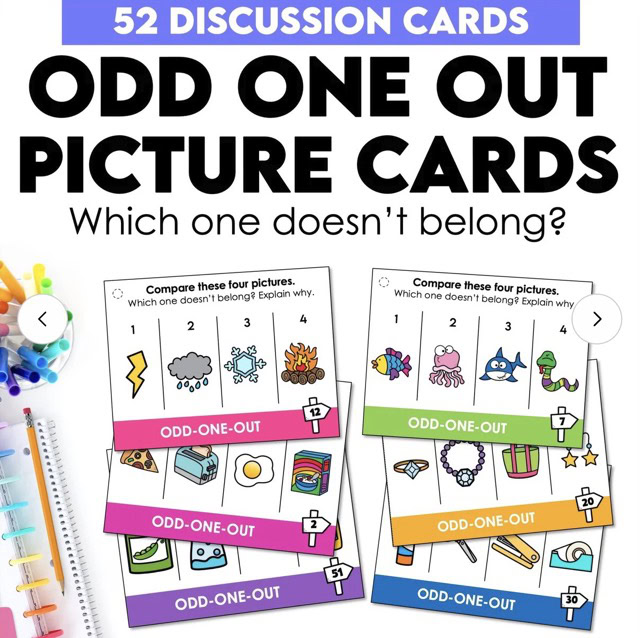
1) Odd-One-Out Discussion Cards (Critical Thinking Speaking)
This is one of my favorite ESL speaking activities for mixed-level classes because there isn’t one “correct” answer—students just have to justify their thinking. That instantly lowers anxiety for low-confidence learners.
How it works: Students look at a set of pictures and decide which one doesn’t belong. Then they explain why using a simple speaking frame: “I think ___ doesn’t belong because ___.” Stronger students add a second reason or challenge a partner’s idea politely.
- Best for: warm-ups, speaking centers, early finishers
- Skills: describing, reasoning, vocabulary, sentence expansion
- Teacher tip: require a follow-up question: “Why?” or “What do you mean?”
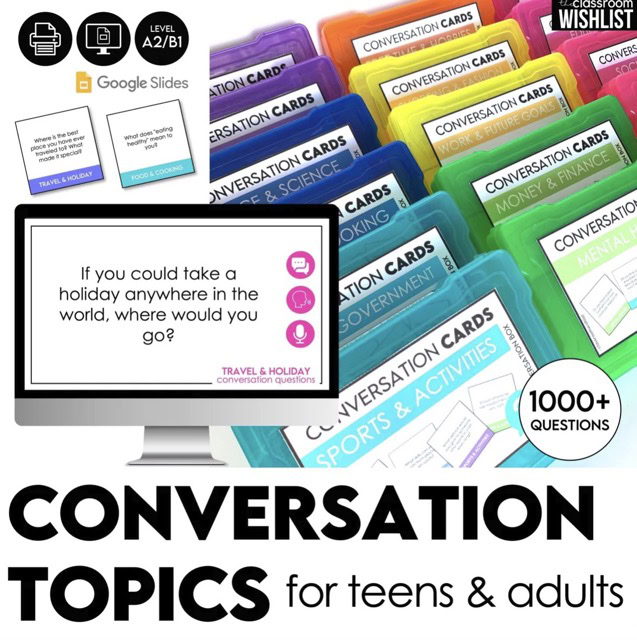
2) Topic-Based Conversation Question Cards (Teens & Adults)
If you teach older students, you already know this: “small talk” questions can feel childish. Topic-based ESL conversation questions work better because they feel real. Students talk longer when prompts connect to their lives—technology, school, money, mental health, travel, jobs, and more.
How it works: Give each pair a card. Students talk for 60–90 seconds, then switch partners (or switch cards). To reduce awkward silence, post three conversation moves on the board: agree, disagree politely, ask a follow-up.
- Best for: daily speaking routine, debate prep, speaking grades
- Skills: fluency, opinion language, academic speaking
- Low-prep upgrade: add a “partner summary” exit ticket (2 sentences)
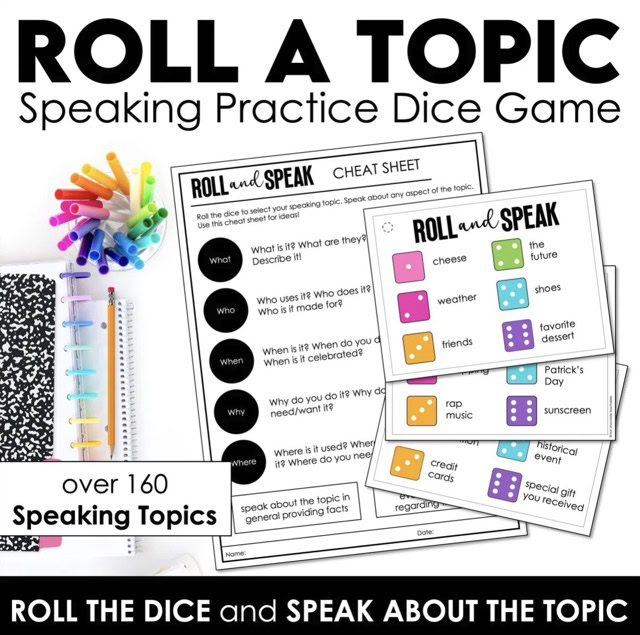
3) Roll-a-Topic Speaking Dice Game (Student-Led Speaking)
When students don’t know what to say, they freeze. A dice routine removes that pressure because the next speaking topic is decided for them. This is one of those speaking games ESL teachers can reuse forever.
How it works: Students roll, land on a topic, and speak for a set amount of time. Beginners can use sentence frames; advanced students add details, examples, or a second question.
- Best for: speaking centers, morning warm-ups, sub plans
- Skills: oral communication, turn-taking, vocabulary retrieval
- Teacher tip: set a simple goal: “Use 2 adjectives” or “Ask 1 follow-up.”
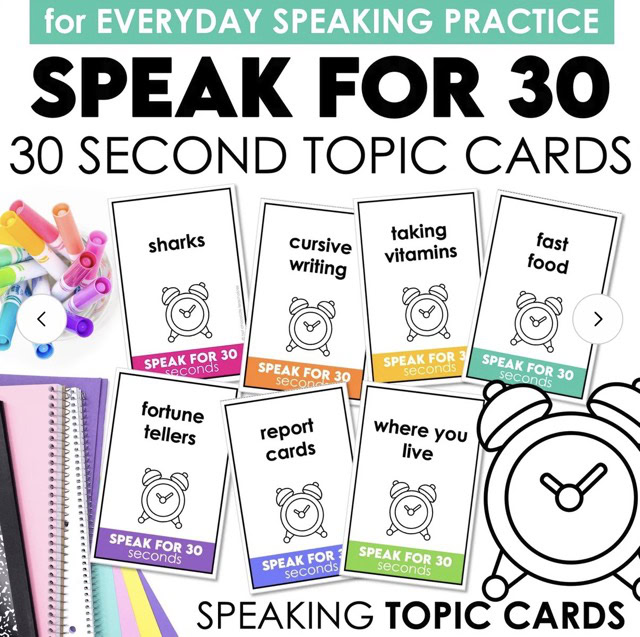
4) Speak for 30 Seconds (Fluency Sprints)
This is the easiest routine for building fluency quickly. Short time limits reduce anxiety, and repeated rounds build confidence. It’s ideal when students are reluctant to speak or you’re dealing with awkward silence.
How it works: Students draw a card and speak for 30 seconds. Partner listens and asks one follow-up question. Then switch roles. The repetition makes speaking feel easier fast.
- Best for: bell ringers, fluency practice, speaking assessment practice
- Skills: fluency, vocabulary access, confidence
- Differentiation: beginners can read a sentence frame; advanced students must include an example.
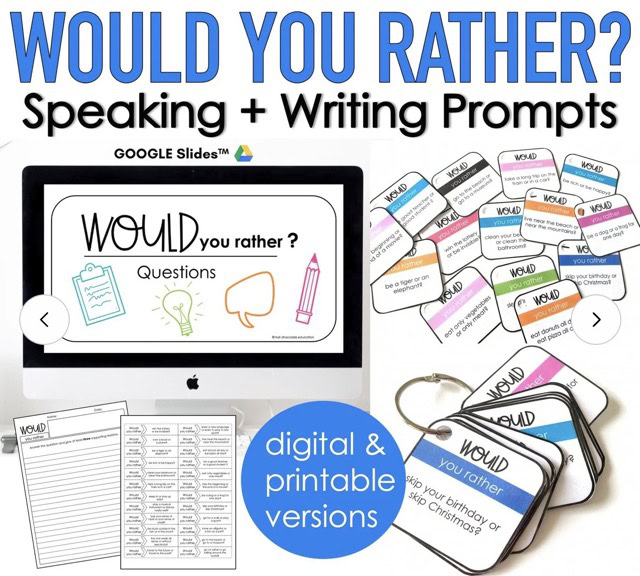
5) Would You Rather? (Low-Pressure Conversation That Still Teaches)
“Would you rather” questions are magic for reluctant speakers because they’re playful, low-stakes, and still create real language. Students have an opinion instantly—and the speaking becomes natural.
How it works: Students choose A or B, then explain why. Add a second step: students must convince a partner to switch sides. That simple twist increases talk time dramatically.
- Best for: brain breaks, Friday fun, community building
- Skills: opinions, because-clauses, persuasion language
- Teacher tip: require one “because” sentence every time.
6) Two-Minute Speed Chats (Rotate Partners, Increase Participation)
If your class goes silent during “discussion,” shorten the time. Two-minute speed chats make speaking feel manageable and keep energy high. Students practice the same question with multiple partners, which builds confidence fast.
- How to run it: set a timer for 2 minutes; students talk; rotate; repeat 3–4 rounds.
- Structured support: post 3 sentence starters on the board.
- Mixed-level hack: pair a confident speaker with a quieter student for the first round only, then let students choose partners.
7) “Ask Me Anything” Partner Interviews (Low-Prep Pair Work Activities ESL)
Interviews feel safer than “discussion” because students have a job: ask questions, listen, then report back. This is a reliable pair work activity ESL teachers can run with almost any topic.
- Setup: give each pair 6–8 question stems (What/When/Where/Why/How).
- Speaking goal: each student must ask 3 follow-up questions.
- Accountability: students report one interesting answer to the class.
8) Picture Talk (Describe, Guess, Extend)
Pictures reduce speaking anxiety because students can point, describe, and build language from what they see. It’s also an easy way to support low-confidence learners who don’t have ideas yet.
- Routine: describe 3 details → guess the situation → add one opinion.
- Sentence frames: “I see…” “I think…” “Maybe…”
- Extension: students write 3 sentences after speaking.
9) Opinion Corners (Movement + Speaking Without Chaos)
Movement helps reluctant speakers because it breaks tension. Opinion corners turn speaking into a simple choice: pick a side, explain, listen, and respond. It’s one of the easiest classroom speaking games to run with mixed-level classes.
- Setup: label corners (Agree / Disagree / Not sure / Depends).
- Prompt: read a statement; students move; then speak with someone in the same corner.
- Upgrade: require one “counterpoint” sentence: “I understand, but…”
10) Chat-Then-Write (Speaking That Improves Writing)
If you want speaking practice that transfers to writing, do it in this order: talk first, write second. Students organize ideas orally, borrow vocabulary from peers, and produce stronger writing with less resistance.
- Routine: 3 minutes speaking → 5 minutes writing → share one sentence.
- Low-prep: one prompt on the board is enough.
- Assessment: collect the final sentence as an exit ticket.
Simple Weekly Routine (So You Don’t Have to Plan Speaking From Scratch)
If you want these ESL speaking activities to actually work, the secret is consistency. Here’s a repeatable routine that keeps prep low and participation high:
- Monday: Would You Rather (2 rounds) + one follow-up question
- Tuesday: Speak for 30 Seconds (partner swap)
- Wednesday: Odd-One-Out small groups + quick share-out
- Thursday: Roll-a-Topic dice centers (10 minutes)
- Friday: Topic conversation cards + partner summary exit ticket
This is the kind of routine that helps students feel safe speaking because they know what to expect—and they get better every week.
Teacher FAQs (Quick Answers for Real Classrooms)
How do I get reluctant ESL students to speak?
Start with structured speaking games (timers, roles, sentence frames) instead of open discussion. Low-pressure formats like “Would You Rather” and “Speak for 30 Seconds” reduce anxiety and increase participation.
What if my ESL classroom has awkward silence?
Silence usually means students don’t know what to say or fear being wrong. Use speaking prompt cards with clear expectations (one reason + one follow-up question). Short time limits help too.
How do I differentiate speaking activities for mixed-level classes?
Keep the task the same but change the output. Beginners use a sentence frame; stronger students add details, examples, or a counterpoint. Mixed-level speaking works best in pairs with clear roles.
What are the best low-prep ESL speaking activities?
Card prompts, dice games, “Would You Rather,” speed chats, interviews, and picture-based speaking are the most repeatable low-prep ESL activities—and they work with almost any vocabulary unit.
Shop the Speaking Activities Featured in This Post
- Odd-One-Out Speaking Task Cards (critical thinking discussion)
- ESL Conversation Card Mega Bundle (topic-based prompts)
- Roll-a-Topic ESL Speaking Dice Game
- Speak for 30 Seconds Fluency Prompt Cards
- Would You Rather Questions (printable + digital)
More Teacher-Friendly Posts You Might Like
Created by Hot Chocolate Teachables
