


L Blends Task Cards for First Grade: Hands-On Beginning Blends Practice
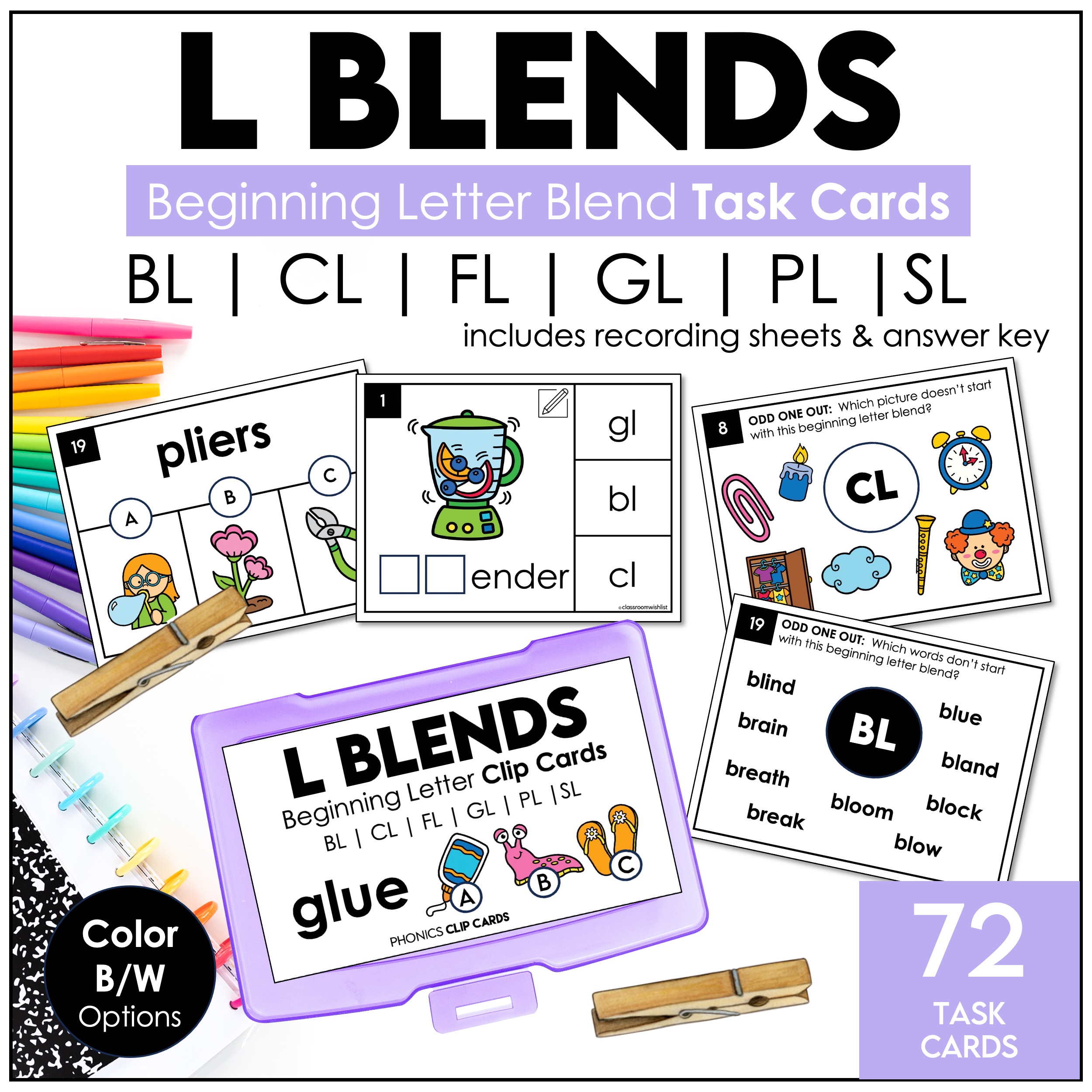
If your students can read CVC words but get stuck on L blends, they don’t need more worksheets—they need short, repeatable decoding reps with immediate feedback. L blends task cards and L blends clip cards help students hear the blend, say it correctly, and recognize it quickly in print. You can use the same cards in phonics centers, small groups, intervention, morning tubs, and early finisher bins—so practice stays consistent all week.
Get the resource here: L Blends Task Cards (Hot Chocolate Teachables) or L Blends Task Cards (TPT).
What Are L Blends?
L blends are consonant blends where a consonant is followed by /l/ at the beginning of a word. Students must pronounce both sounds smoothly—without inserting an extra vowel—then blend into the rest of the word.
Examples of common L blend words include:
- bl: blue, black, block
- cl: clap, clock, clean
- fl: flag, flip, float
- gl: glad, globe, glue
- pl: plan, plug, plant
- sl: slip, slow, slam
Many students can name letters and even read simple words, but beginning blends add complexity: two consonants, two sounds, faster blending, and less room for guessing.
Why Students Need Practice with Beginning L Blends
Students don’t master beginning L blends after one mini-lesson. They need repeated practice that targets the exact skill: hearing the blend, saying it clearly, and recognizing it in words.
What tends to go wrong (and how to fix it fast)
- Extra vowel insertion: students read “fuh-lag” instead of “flag.”
Quick fix: model a fast blend snap: /fl/ (one sound move), then blend: /fl/ + /ag/ → flag. - Dropping the first sound: students read “lip” for “slip.”
Quick fix: require a “blend tap” before reading: tap the first two letters, say /sl/. - Picture guessing: students choose the picture without decoding.
Quick fix: ask for proof: “Which blend do you see at the start?”
This is why hands-on L blends practice works better than worksheet-only pages. Task cards create more decoding turns, and you can catch mistakes in the moment.
L Blends to Teach: BL, CL, FL, GL, PL, and SL
This resource focuses on the most common BL CL FL GL PL SL activities for early readers. Teaching them together helps students notice the pattern: two consonants, both sounds, then the vowel.
Teacher setup tip (60 seconds before centers)
Before students start independent practice, do a quick oral warm-up:
- Say the blend: “/bl/” and have students repeat (no “buh-luh”).
- Say a word: “blue,” students repeat and clap once.
- Repeat with cl, fl, gl, pl, sl.
This tiny routine reduces the most common blend error: adding a vowel sound between consonants.
Hands-On Ways to Practice L Blends
If you’re planning L blends activities for first grade, aim for short, repeatable routines that don’t require new directions every day. The simplest plan is to rotate task types while keeping the same target blends.
A no-prep weekly routine (centers + small groups)
- Day 1: clip cards (blend recognition)
- Day 2: word-to-picture matching (decode + meaning)
- Day 3: odd one out (listening + decoding accuracy)
- Day 4: mixed review (students choose a card type)
- Day 5: quick check (5 cards) + one-sentence oral reading
Students get repeated exposure to L blends phonics patterns without feeling like they’re doing the same worksheet again and again.
Using L Blends Task Cards in Phonics Centers
L blends task cards are ideal for phonics centers for beginning blends because the format stays consistent. Students spend more time decoding and less time figuring out what to do.
Materials list (center bin)
- Printed task cards (lamination optional)
- Clothespins or mini clips (for clip cards)
- Dry-erase marker (if laminated)
- Recording sheet (optional accountability)
Fast checking workflow
Use a “teacher check” moment at the end of the rotation:
- Student reads 2 cards aloud.
- You listen for blend accuracy (no inserted vowel).
- Give one quick correction + one praise point.
This makes your behavior-free accountability simple: students know they’ll read to you briefly, so they focus during independent work.
Small Group Ideas for L Blends Practice
Small groups are perfect for first grade beginning blends practice because you can correct errors immediately and give students the exact repetition they need.
10-minute small group routine
- Warm-up (1 minute): quick oral blend drill: bl, cl, fl, gl, pl, sl.
- Guided decoding (5 minutes): students read 6–8 cards aloud.
- Write or build (2 minutes): students write one word from a card or build with letter tiles.
- Quick check (2 minutes): students read one sentence using an L blend word.
2–3 concrete examples (so you can picture it)
- Sample prompt: “Find the word that starts with fl.”
Sample student response: “fl-ag… flag.” - Common error: “fuh-lag.”
Fix: “Say it fast: /fl/. Now blend: /fl/ + /ag/.” - Success looks like: student reads the blend smoothly, without inserting a vowel, and matches the correct picture.
This structure also supports L blends reading intervention activities because it’s quick, targeted, and easy to repeat over several sessions.
How to Use Clip Cards for Beginning Blend Recognition
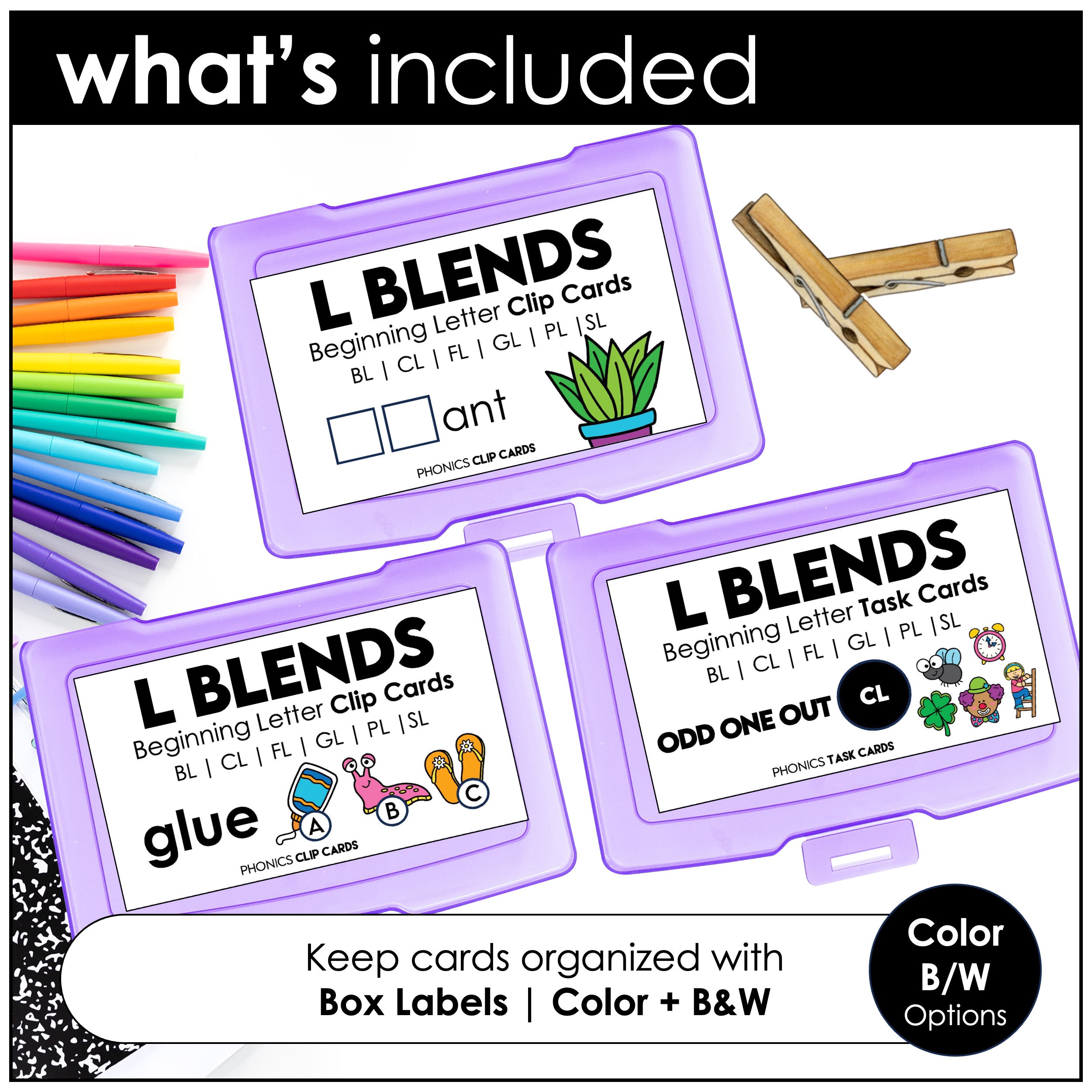
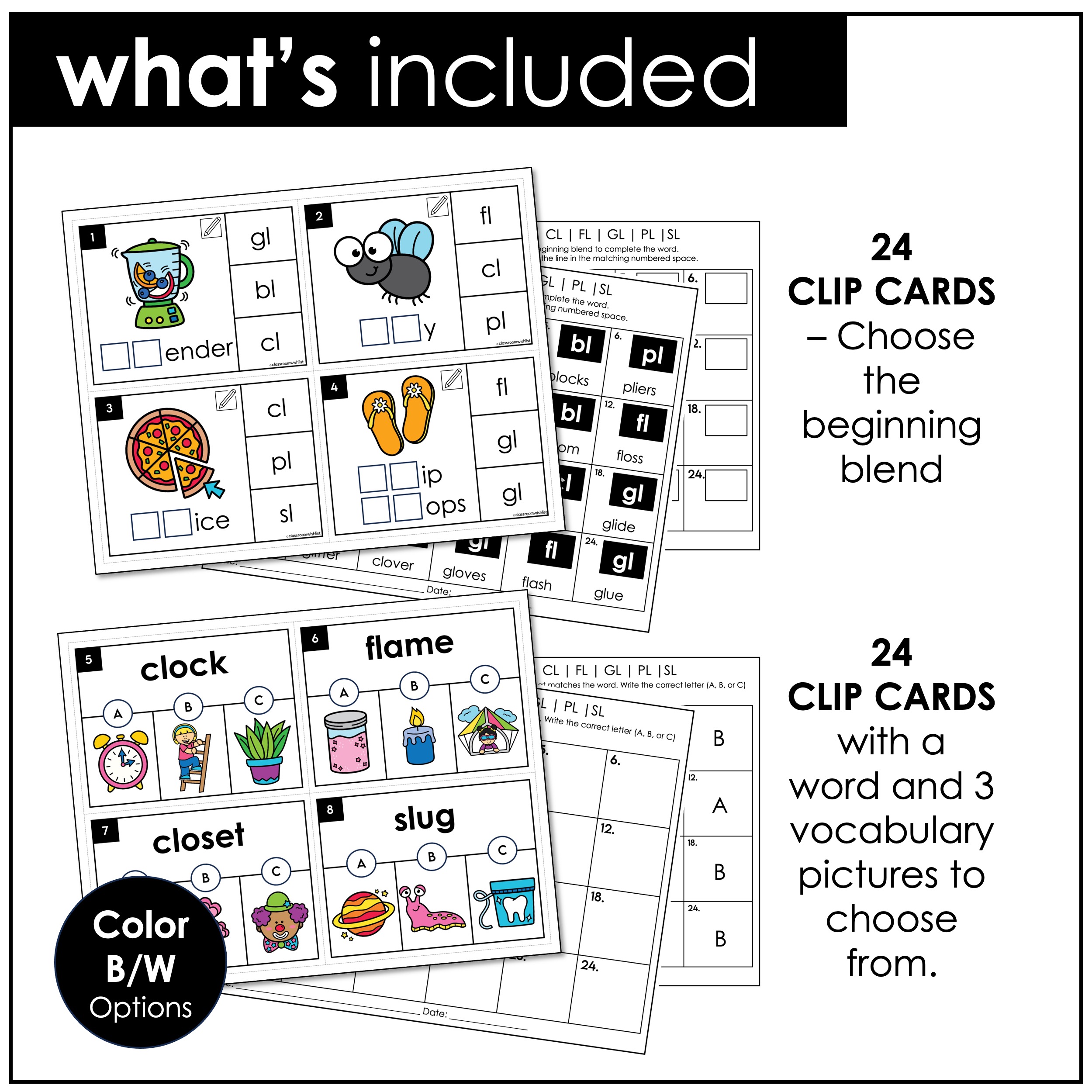
L blends clip cards are a hands-on way to practice blend recognition without heavy writing. Students read, identify the blend, and clip the correct answer—fast reps, clear evidence.
Differentiation
- Support: students whisper-read to a buddy before clipping.
- Challenge: students say a full sentence after clipping (“I see a blue…”, “The plant is…”).
Clip cards are especially effective in morning tubs and intervention because students can complete multiple cards quickly without fatigue.
Word-to-Picture Matching for L Blend Vocabulary
Word-to-picture matching turns decoding into meaning. Instead of “finding the blend,” students must decode the whole word and connect it to the correct picture—great for vocabulary and comprehension.
Quick teacher move that boosts accuracy
Before students match, require the “blend tap” step: tap the first two letters and say the blend (/pl/, /sl/, etc.). This reduces guessing and improves blend recognition.
Odd One Out Activities for Listening and Decoding Practice
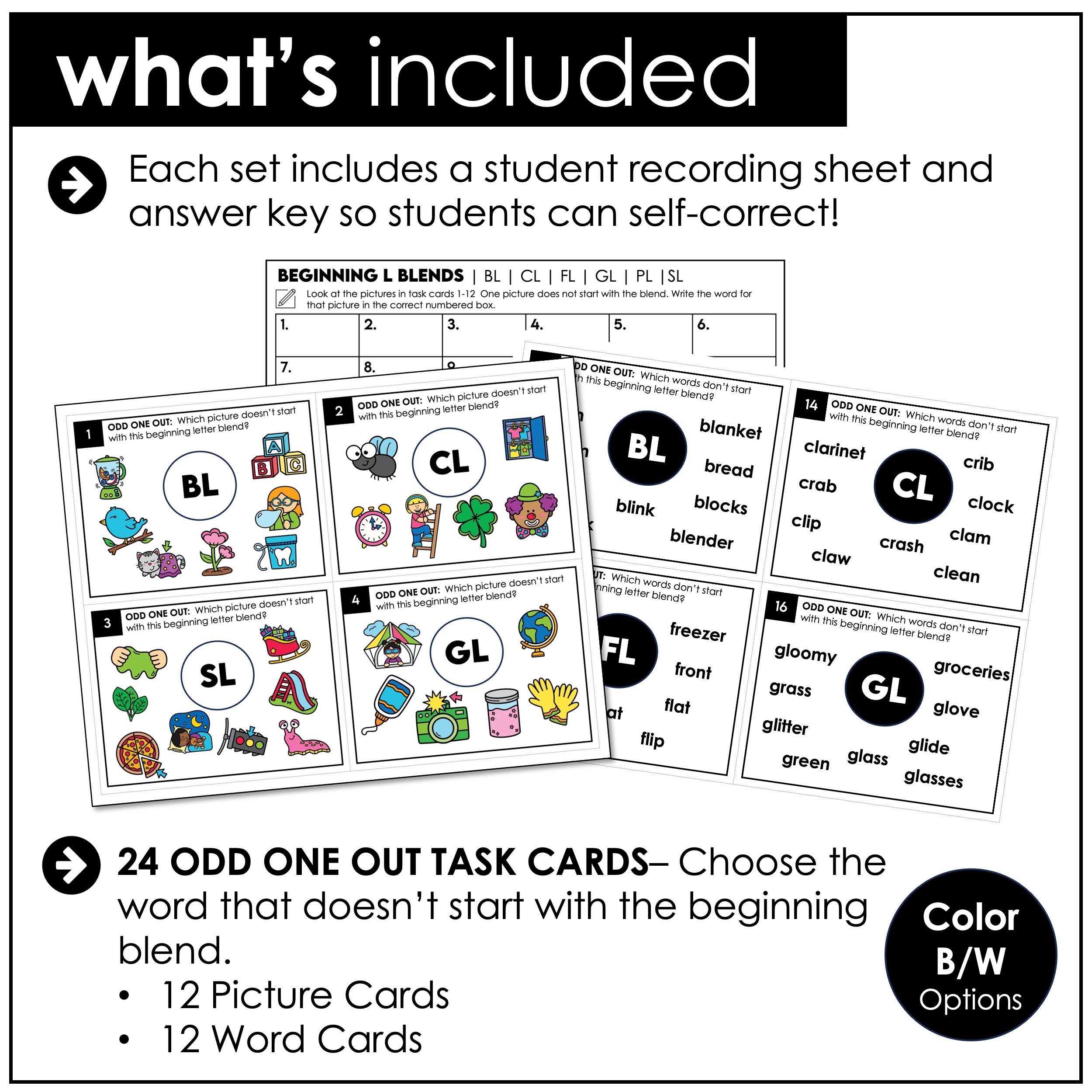
Odd one out tasks build careful attention. Students decide which word/picture doesn’t belong—often because it begins with a different blend. This forces students to listen and decode accurately instead of relying on general theme clues.
Teacher tip: Require students to explain: “It starts with sl. The others start with cl.” That short explanation strengthens phonics language and metacognition.
What’s Included in the L Blends Task Cards Resource
This resource is designed for repeated, hands-on L blends practice and includes multiple activity types so you can use it in centers, small groups, and intervention without extra prep.
Product links: L Blends Task Cards (Hot Chocolate Teachables) and L Blends Task Cards (TPT).
- Printable L blends task cards targeting BL, CL, FL, GL, PL, SL
- L blends clip cards for quick recognition and decoding reps
- Word-to-picture matching cards
- Odd one out task cards
- Student recording sheets (optional)
- Answer keys for fast checking
- Color and black-and-white printing options
- Box labels for easy organization
Where to Use These L Blends Activities
Because the practice is short and repeatable, these L blends activities fit into multiple parts of your day:
- Phonics centers: independent decoding practice with clear routines
- Small groups: targeted skill-building with immediate correction
- Reading intervention: extra reps for students who need slower blending work
- Morning tubs: quiet, hands-on word work
- Early finishers: meaningful practice instead of busywork
- Sub plans: predictable tasks with an answer key
Success criteria: Students can (1) identify the beginning blend, (2) say both consonant sounds smoothly without adding a vowel, and (3) read and match the word accurately. When that happens, L blends phonics starts to transfer into real reading.
Shop the L Blends Task Cards
More Blog Posts You Might Like
- S blends phonics games: a no-prep routine for bingo, clip cards, and card games
- Teacher Toolkit Membership: unlimited ESL resources for busy teachers
- Classroom reward punch cards for simple routines and goal tracking
Created by Hot Chocolate Teachables
