


R Blends Activities for First Grade Phonics Practice
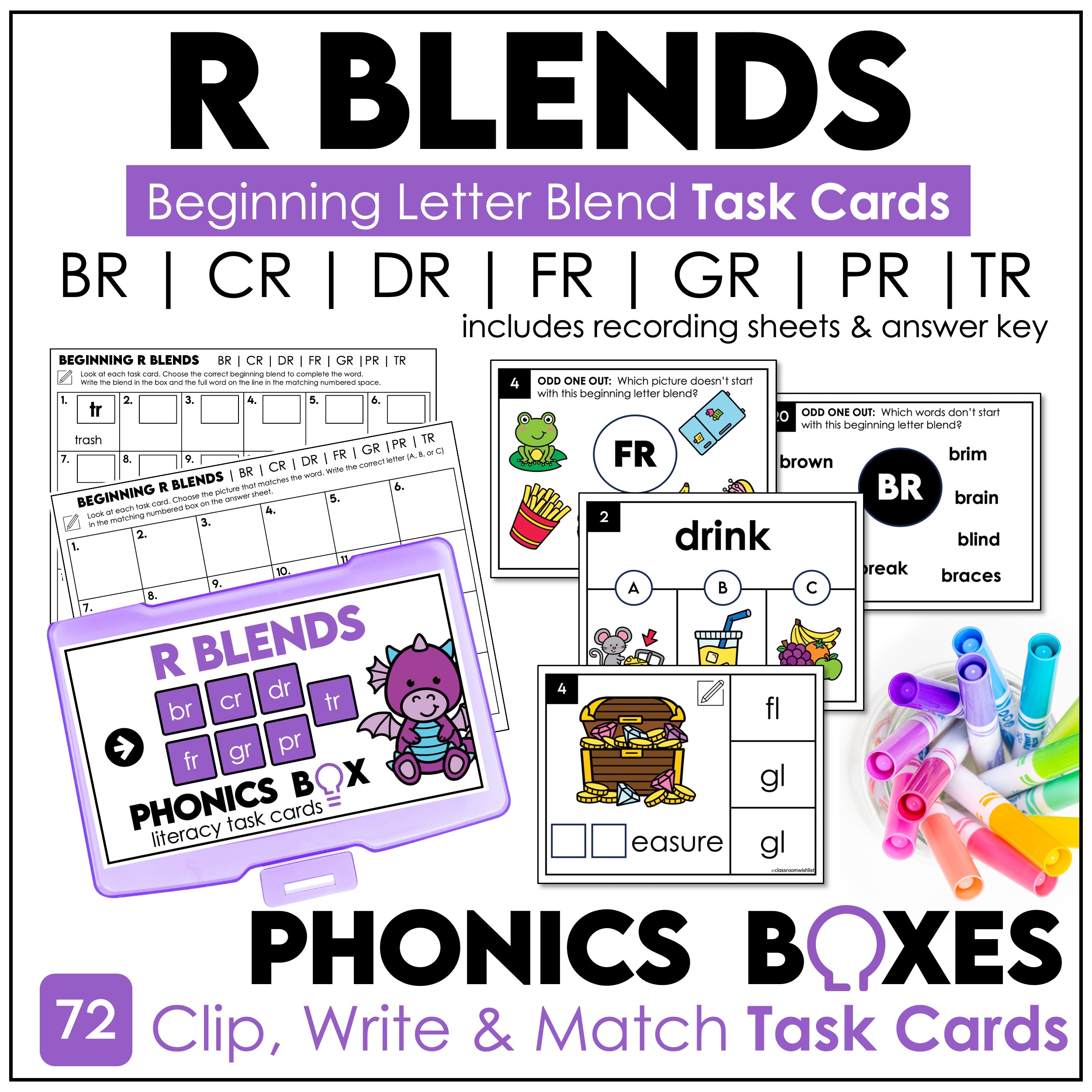
If your students can read CVC words but stumble when a word starts with R blends, they don’t need another worksheet packet—they need short, repeatable decoding reps with quick feedback. R blends task cards and R blends clip cards help students hear the blend, say both sounds correctly, and recognize the pattern in print. This is a hands-on routine you can use in phonics centers, small groups, intervention, morning tubs, and early finisher bins all year.
Get the resource here: R Blends Phonics Task Cards (Hot Chocolate Teachables) or R Blends Task Cards (TPT).
What Are R Blends?
R blends are consonant blends that begin with one consonant sound followed by /r/ at the start of a word. Students must pronounce both sounds smoothly and quickly—without adding an extra vowel—then blend into the rest of the word.
Examples of common R blend words include:
- br: brush, brick, brown
- cr: crab, crown, crash
- dr: drum, drop, drive
- fr: frog, free, fruit
- gr: green, grapes, grin
- pr: press, prize, proud
- tr: tree, train, truck
When teachers say students “struggle with beginning blends,” it often shows up as skipping a sound (reading train as “tain”) or inserting a vowel (saying “tuh-rain”). Targeted beginning R blends practice fixes those habits by making students slow down and notice the blend.
Why Students Need Practice with Beginning R Blends
Students rarely learn beginning R blends from a single phonics lesson. They need repeated practice that is short, focused, and consistent—especially for first grade readers who are still building decoding stamina.
What tends to go wrong (and what helps)
- Extra vowel insertion: students read “tuh-rain” instead of “train.”
Quick fix: practice a fast “blend snap”: /tr/ (one quick move), then blend: /tr/ + /ain/ → train. - Dropping the first sound: students read “rain” for “brain.”
Quick fix: require a “blend tap”: tap the first two letters and say /br/ before reading the word. - Guessing from pictures: students choose a picture without decoding.
Quick fix: ask for proof: “Which blend do you see at the beginning?”
This is why hands-on R blends practice works better than relying only on worksheets. Task cards create more decoding turns per minute—and you can correct errors quickly during centers and small groups.
R Blends to Teach: BR, CR, DR, FR, GR, PR, and TR
This set targets the most common BR CR DR FR GR PR TR activities for early phonics instruction. Teaching them as a group helps students recognize the pattern: two consonants, two sounds, then the vowel.
Teacher tip: a 60-second warm-up that prevents the “extra vowel” problem
- Say the blend sound once: “/br/.” Students repeat quickly (no “buh-ruh”).
- Say a word: “brush.” Students repeat and clap once.
- Repeat with cr, dr, fr, gr, pr, tr.
When students hear and say blends correctly first, they read them more accurately during independent work.
Hands-On Ways to Practice R Blends
The easiest way to plan low prep R blends activities is to keep the blends the same but rotate the task type. Students get repeated exposure without boredom, and your directions stay consistent.
A simple weekly routine (centers + small groups)
- Day 1: clip cards (blend recognition)
- Day 2: word-to-picture matching (decode + meaning)
- Day 3: odd one out (listening + decoding accuracy)
- Day 4: mixed review (students choose the task style)
- Day 5: quick check (5 cards) + one-sentence oral reading
That “print once, use often” routine is what makes phonics task cards so teacher-friendly.
Using R Blends Task Cards in Phonics Centers
R blends task cards are made for phonics centers for beginning blends. The format stays predictable, so students spend their energy decoding—not figuring out the directions.
Center setup that stays organized
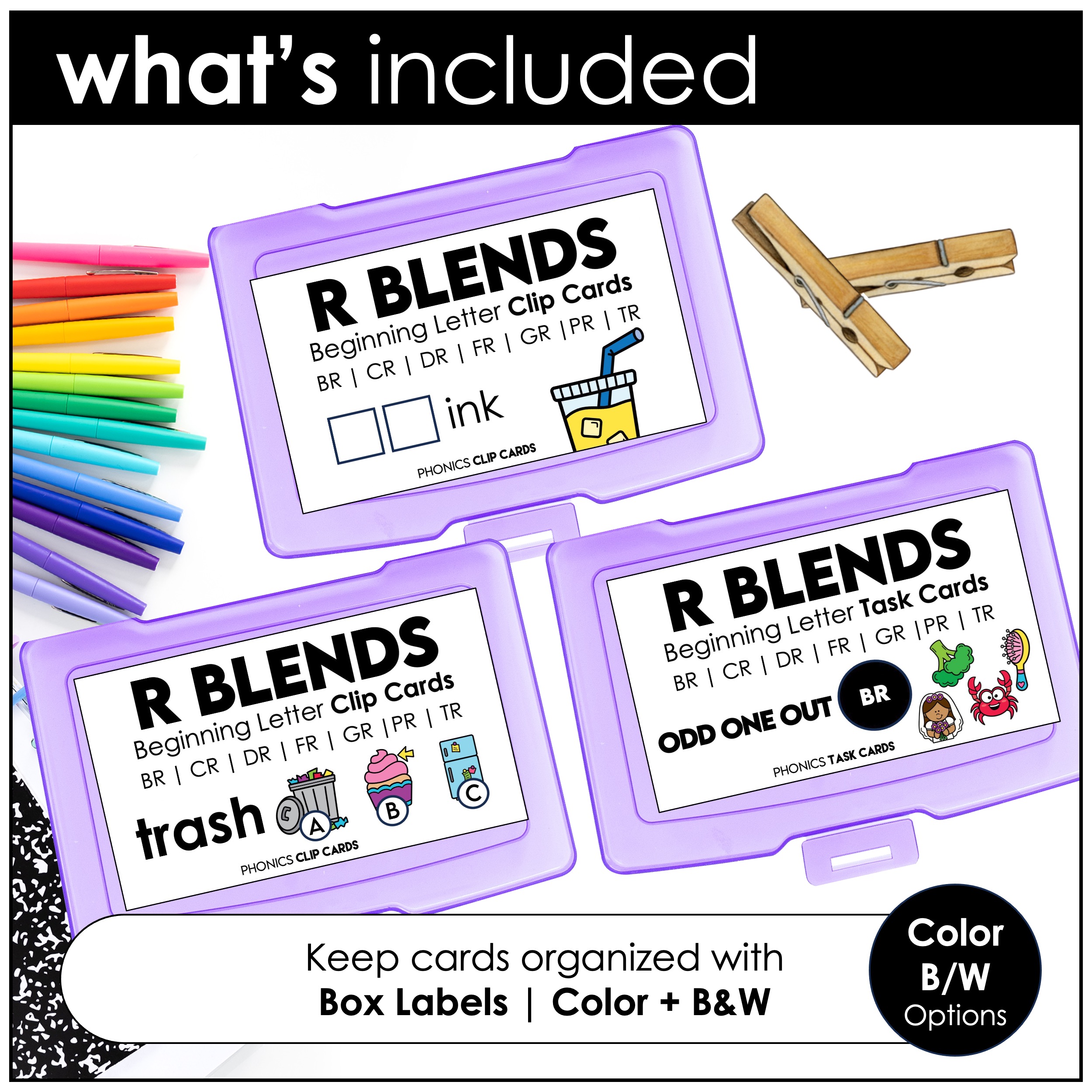
- Store the deck in a small bin with a label.
- Add clothespins (for clip cards) and/or a recording sheet.
- Include one direction card: “Read. Say the blend. Clip the answer.”
- Reuse the same routine for 2–3 weeks to build automaticity.
Checking workflow (fast and realistic): At the end of the rotation, have each student read 2 cards aloud. You listen for blend accuracy and correct the one common error (usually the inserted vowel). That’s enough to keep practice accountable without turning centers into constant testing.
Small Group Ideas for R Blends Practice
Small groups are the best place for first grade beginning blends practice because you can hear exactly what students are doing and correct blend errors immediately. This also makes the resource useful for R blends reading intervention activities.
10-minute small group routine
- Warm-up (1 minute): oral blend drill: br, cr, dr, fr, gr, pr, tr.
- Guided decoding (5 minutes): students read 6–8 cards aloud.
- Write/build (2 minutes): students write one R blend word or build it with tiles.
- Quick transfer (2 minutes): students read one sentence using an R blend word.
Concrete examples (so you can picture it)
- Sample task: Student reads frog and matches the correct picture.
Sample response: “fr-og… frog.” - Common mistake: “fuh-rog.”
Fix: “Say it fast: /fr/. Now blend: /fr/ + /og/.” - Success looks like: student says both consonant sounds smoothly and reads the word accurately.
How to Use Clip Cards for Beginning Blend Recognition
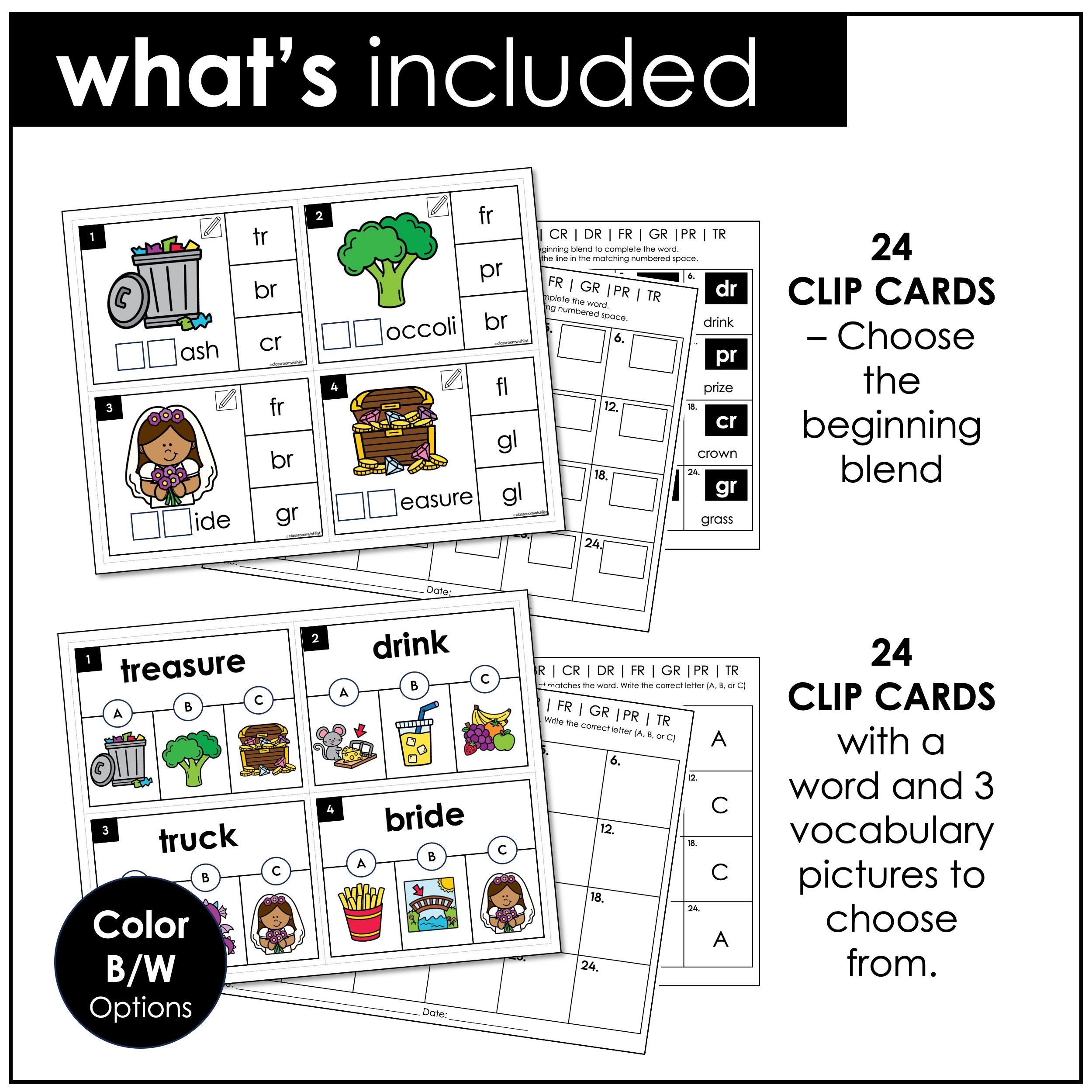
R blends clip cards give students quick reps without heavy writing. Students read the prompt, identify the correct blend, and clip their answer—simple, hands-on, and perfect for independent practice.
Differentiation ideas
- Support: students whisper-read to a buddy before clipping.
- Challenge: after clipping, students say a full sentence using the word (“The frog is green.”).
Word-to-Picture Matching for R Blend Vocabulary
Word-to-picture matching is where decoding becomes meaningful. Students aren’t only identifying blends—they’re reading full R blend words and connecting them to meaning. These R blends word work activities support vocabulary and comprehension while keeping the phonics focus tight.
A tiny move that boosts accuracy
Require a “blend tap” before matching: students tap the first two letters and say the blend (/br/, /tr/, etc.). This reduces guessing and reinforces the habit of checking the beginning blend.
Odd One Out Activities for Listening and Decoding Practice
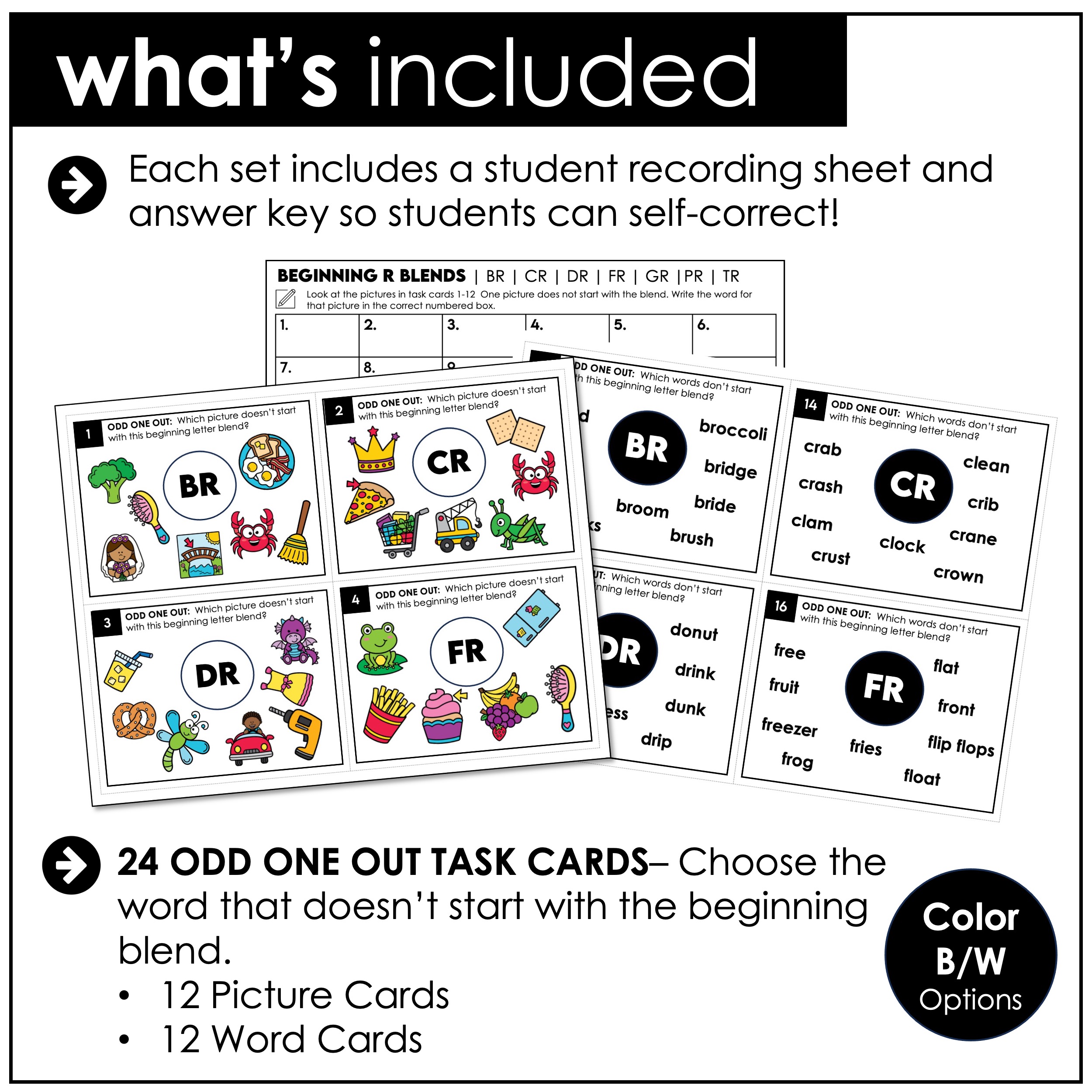
Odd one out tasks build careful attention and listening. Students decide which word or picture doesn’t belong—often because it starts with a different blend. This forces students to decode instead of choosing based on a general theme.
Common errors + fixes
- Error: choosing based on picture theme, not sound.
Fix: require the reason: “Which blend does it start with?” - Error: guessing without reading.
Fix: “Say the first two sounds first, then choose.”
What’s Included in the R Blends Task Cards Resource
This resource is designed for repeated, hands-on R blends practice—without relying only on worksheets. It’s ready for phonics centers, small groups, and intervention.
Product links: R Blends Task Cards (Hot Chocolate Teachables) and R Blends Task Cards (TPT).
- Printable R blends task cards for BR, CR, DR, FR, GR, PR, TR
- R blends clip cards for quick recognition and decoding reps
- Word-to-picture matching cards
- Odd one out phonics task cards
- Student recording sheets (optional)
- Answer keys for fast checking
- Color and black-and-white options
- Box labels for organization
Where to Use These R Blends Activities
Because the tasks are short and repeatable, these R blends activities fit into many parts of your day:
- Phonics centers: independent practice with consistent routines
- Small groups: targeted decoding + immediate feedback
- Reading intervention: extra reps for students who need slow, careful blending
- Morning tubs: hands-on word work that feels doable
- Early finishers: meaningful practice instead of busywork
- Sub plans: predictable tasks with a teacher key
Success criteria: students can (1) identify the beginning blend, (2) say both consonant sounds smoothly without adding a vowel, and (3) read and match the word accurately. When that happens, beginning R blends phonics activities start transferring into real reading.
Shop the R Blends Task Cards
More Blog Posts You Might Like
- Hands-on L blends practice for first grade phonics centers and small groups
- S blends phonics games with a no-prep routine for bingo, clip cards, and card games
- Teacher Toolkit Membership: unlimited ESL resources for busy teachers
Created by Hot Chocolate Teachables
